Jackery HomePower 3600 Plus Review: Solar Generator for Home Backup and RV Power
This Jackery HomePower 3600 Plus review looks at a large-capacity solar generator built for essential home backup, RV power, emergency use, and longer outage planning. Based on the provided product information, this model offers a 3584Wh LFP battery, 3600W AC output, expansion up to 21kWh per unit, and up to 43kWh with multiple units. The reviewed bundle is shown with 2 × 200W solar panels, and the listing positions it as an essential home backup system for home use, emergencies, and RVs.
As an Amazon Associate, we may earn from qualifying purchases.
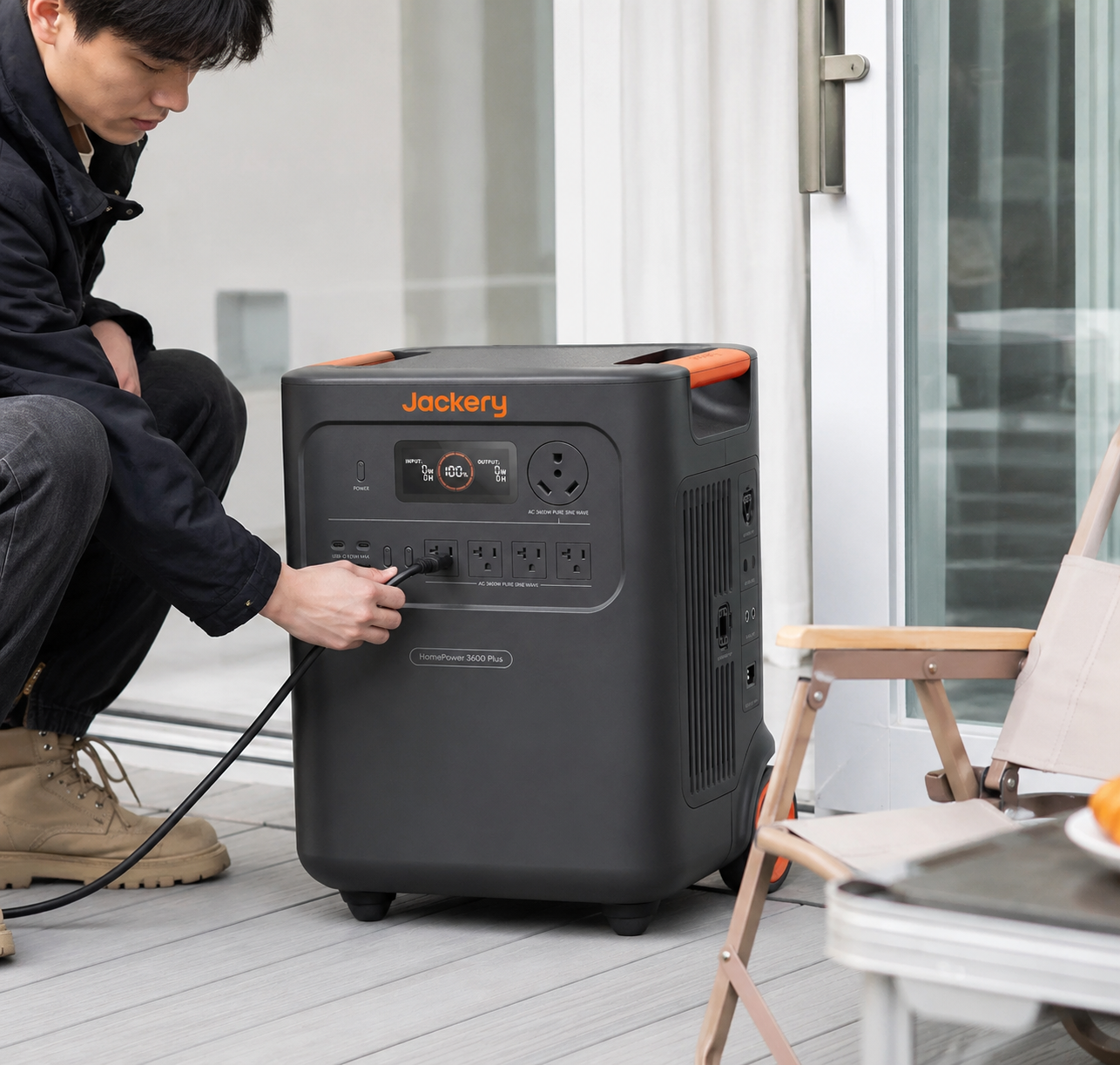
The HomePower 3600 Plus is not a small camping battery. It is a much larger portable power station aimed at people who want to keep refrigerators, kitchen appliances, computers, routers, lights, RV essentials, and critical circuits running during outages. It still has wheels and a retractable handle, but its real purpose is not backpack-style portability. It is designed to roll from room to room, garage to kitchen, or home to RV setup when needed.
Quick Verdict
The Jackery HomePower 3600 Plus makes the most sense for homeowners who want a powerful plug-and-play backup battery without immediately moving into a permanent whole-home battery installation. The 3584Wh capacity is large enough to support meaningful outage use, while the 3600W output gives it enough headroom for appliances that smaller 1kWh power stations may not handle comfortably.
Jackery HomePower 3600 Plus Portable Power Station
I would consider it a strong option for refrigerator backup, home office continuity, kitchen appliance support, RV trips, and emergency preparedness. It is especially interesting if you want a large LFP battery that rolls like luggage and can work with solar panels, AC charging, and a manual transfer switch setup.
The main tradeoffs are size, cost, and the need to understand your power loads. The product material mentions 7200W in parallel and 240V output only when using two HomePower 3600 Plus units with the Jackery Connector, which is sold separately. That matters because a single unit should be treated as a 120V system unless your setup includes the proper second unit and accessories.
Key Specifications
The HomePower 3600 Plus is positioned above typical 1000Wh and 2000Wh portable power stations. Its specs are closer to a serious home backup unit, but it keeps a wheeled, moveable form factor.
| Feature | Listed Detail |
|---|---|
| Product | Jackery HomePower 3600 Plus Portable Power Station |
| Bundle shown | HomePower 3600 Plus with 2 × 200W solar panels |
| Battery capacity | 3584Wh |
| Battery chemistry | LFP battery |
| AC output | 3600W |
| Parallel output | 7200W in parallel, according to product material |
| Voltage | 120V from one unit; 240V requires two units and Jackery Connector, sold separately |
| Expandability | Up to 21kWh per unit; up to 43kWh with multiple units |
| Cycle life claim | 6,000 cycles; battery retains 70% capacity after 6,000 cycles |
| Lifespan claim | 10+ years |
| Coverage claim | 5 years coverage shown |
| Operating temperature claim | Reliable operation from -4°F to 113°F shown |
| Weight claim | 77 lbs |
| Design | Wheels and retractable handle |
| Ports shown | 4 × AC output, TT-30 RV port, 2 × USB-C ports, 2 × USB-A ports |
| USB-C output | 100W max |
| USB-A output | 18W max |
| RV port | TT-30 RV port, 120V / 30A shown |
| UPS switching | ≤10ms UPS switching shown |
| Charging options | AC, solar, hybrid AC + solar, and gas generator charging shown |
| Dual charging claim | 80% in 75 minutes by combining AC + solar; full charge in 2 hours |
| Gas generator charging claim | Full charge in 2.5 hours shown |
| Shipping note | Power station and solar panels may ship separately |
The headline numbers are strong, but the context matters. A 3584Wh battery can keep essentials running much longer than a 1000Wh unit, but runtime still depends on load. A refrigerator cycling at low average wattage is very different from a coffee machine, oven, heater, washer, or portable AC.
First Impressions
The first impression is that the HomePower 3600 Plus is trying to solve the “large but still moveable” problem. Many high-capacity backup batteries are difficult to reposition once installed, while smaller portable power stations are easier to carry but too limited for extended home backup. Jackery’s design lands between those two categories.
The product image describes it as the world’s lightest, smallest 3.6kWh LFP model, with claims of being 34% more compact and 29% lighter than others in its class. I would treat those comparison claims as brand-provided marketing unless independently verified, but the design direction is clear: Jackery wants this to feel less like a stationary battery cabinet and more like a large rolling appliance.
Design and build feel
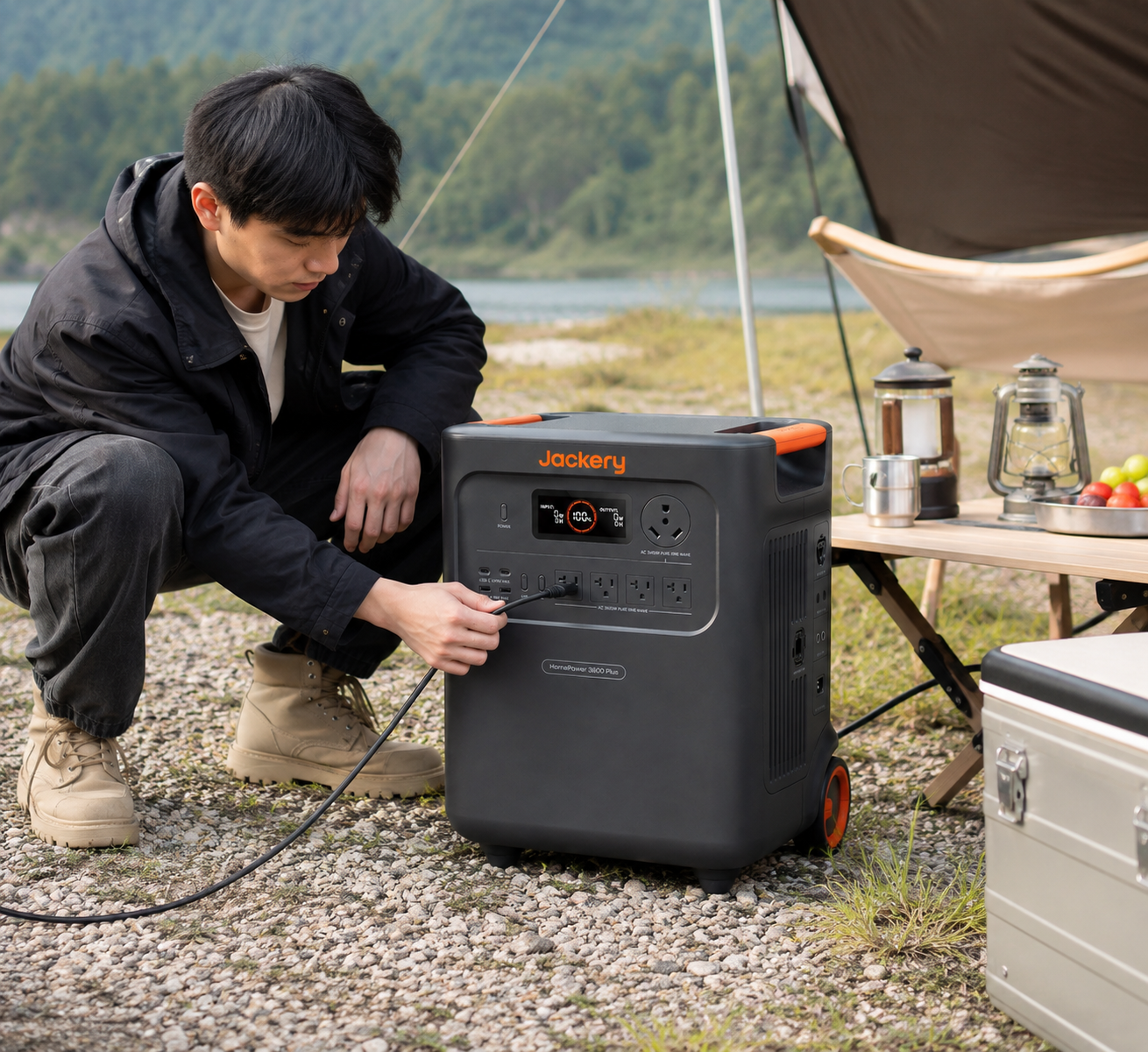
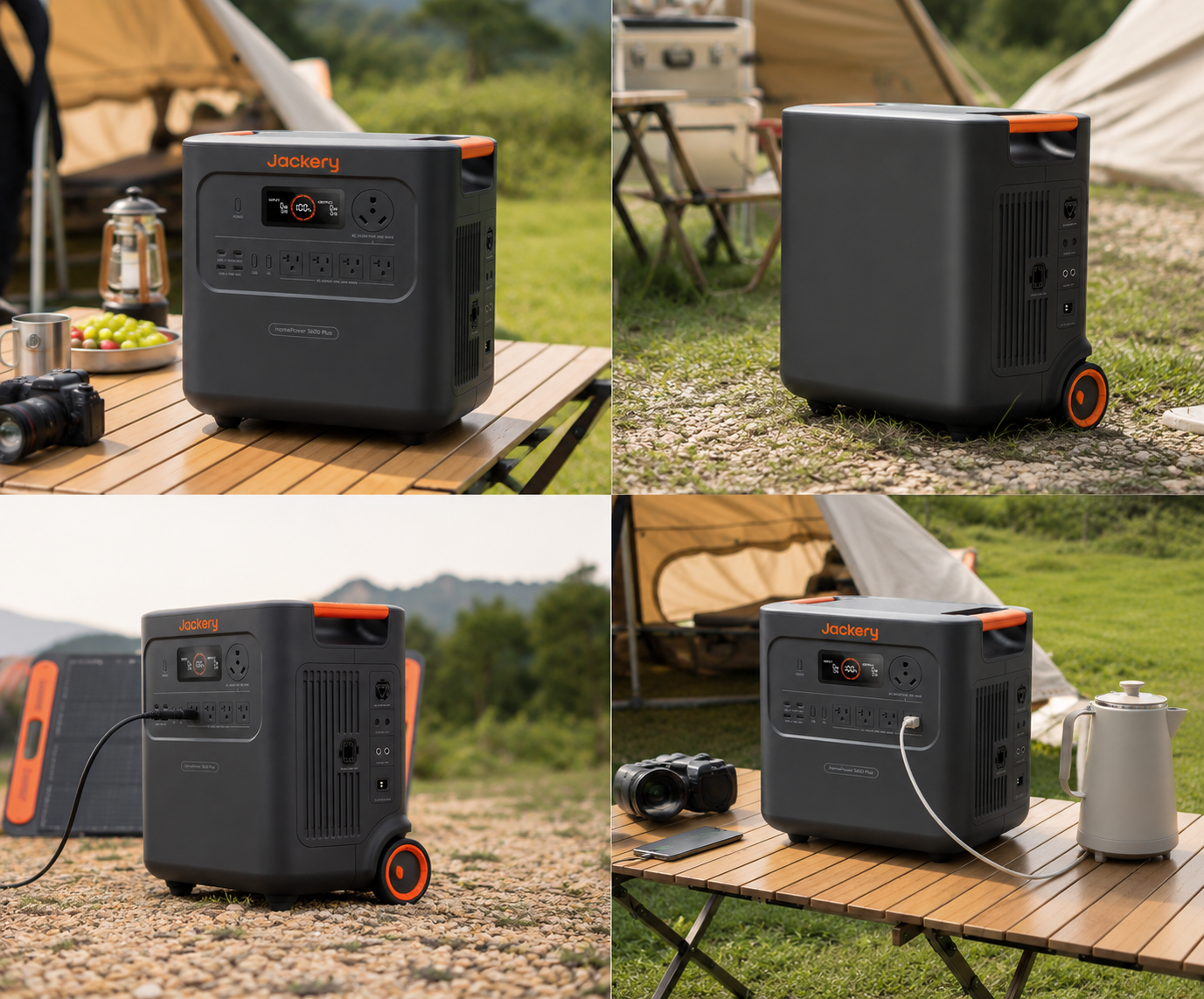
The unit has a dark gray body, orange Jackery accents, integrated side handles, wheels, and a retractable handle. At a listed 77 lbs, it is not something most people will want to lift frequently. The wheels are important. This is the kind of power station you roll across a floor, driveway, garage, or RV pad rather than carry by hand.
Jackery HomePower 3600 Plus Portable Power Station
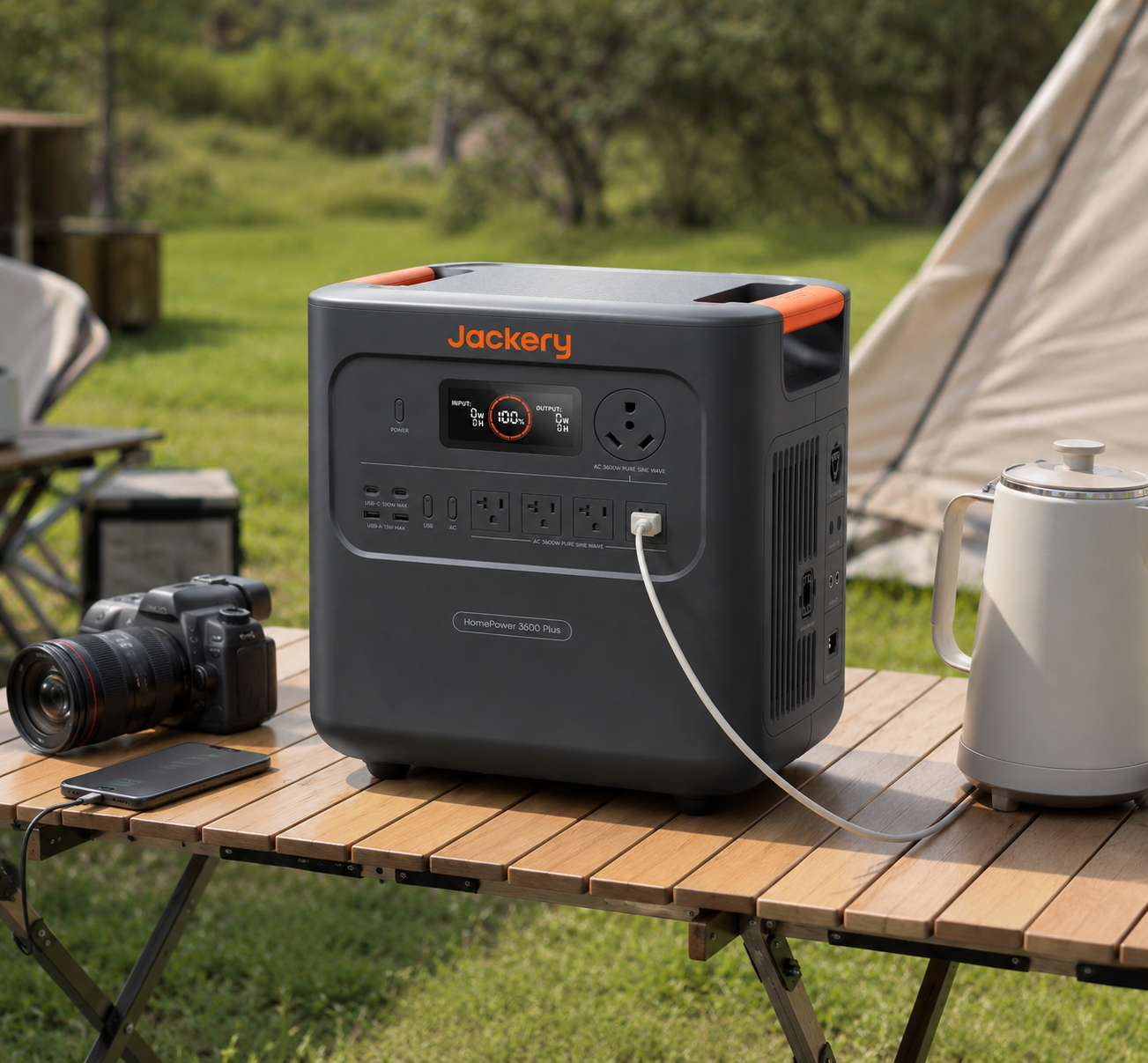
The front panel appears organized, with AC outlets, USB ports, display controls, and a larger round output port area. The layout is more home-focused than pocket-device-focused. It is clearly meant to support appliances and household loads, not just phones and tablets.
Solar panel bundle
The Amazon listing image shows the HomePower 3600 Plus with 2 × 200W solar panels. That makes the bundle more useful for outage recovery and RV use than a battery-only package. Still, two 200W panels are not the same as a large roof solar system. In real-world use, sunlight, angle, weather, temperature, and shading will affect charging speed.
Setup and Daily Use
For simple use, the HomePower 3600 Plus should be easy: charge the unit, plug in devices, press the power button, and monitor the display. The product information emphasizes plug-and-play backup, which is important for households that do not want a complicated installation before they can use emergency power.
That said, the more advanced backup options require careful planning. The image mentions complete backup for critical circuits through a manual transfer switch and a NEMA TT-30 connection. This is the kind of setup where users should follow the manual and use qualified electrical help when connecting household circuits. A portable power station is simpler than a permanent whole-home system, but circuit backup should still be treated seriously.
Charging options
The product material lists four charging options. It says the unit can be fully recharged from 0–100% in 2 hours via hybrid AC + solar, in 4 hours via AC, or in 2.5 hours through a gas generator. It also shows AC + solar fast dual charging with 80% in 75 minutes and full charge in 2 hours when combining AC and solar input.
The dual-charging feature is useful for storm preparation. If a weather alert arrives and the battery is not full, faster charging can make the system ready sooner. Solar can also help recover energy during a longer outage, especially when used during daylight hours.
Gas generator charging should be handled carefully. Any fuel generator must be operated outdoors, away from windows, doors, vents, and living areas because of exhaust risk. The HomePower 3600 Plus battery itself is quieter and cleaner during discharge, but charging it from a gas generator still requires standard generator safety.
Jackery HomePower 3600 Plus Portable Power Station
Daily home use
For daily outage readiness, I would keep the HomePower 3600 Plus charged, stored somewhere accessible, and tested with your priority devices. The best time to find out whether your refrigerator, router, computer, or appliance works as expected is before a storm, not during one.
The UPS switching feature also makes daily use more interesting. The product material shows ≤10ms UPS switching and instant backup for home essentials such as computers and medical equipment. This can be useful for home offices and sensitive devices, but buyers should verify compatibility for any critical or medical equipment before relying on it.
Cleaning Performance
For a solar generator, “cleaning performance” means clean electrical output, stable appliance support, runtime under real loads, and how well the power station handles common outage situations. The HomePower 3600 Plus is clearly built for more serious loads than compact camping batteries.
Home appliance performance
The product material shows examples such as a fridge, cooker, electric oven, coffee machine, washer, portable AC, and lights. These are exactly the kinds of devices people care about when the power goes out.
One image shows a fridge rated at 200W lasting 2–3 days, a cooker at 330W lasting 7.5 hours, an electric oven at 800W lasting 3.6 hours, and a coffee machine at 1120W lasting 2.6 hours. These are useful examples, but real performance depends on the exact appliance, usage pattern, thermostat cycling, ambient temperature, and how much reserve battery you want to keep.
The most important takeaway is that the HomePower 3600 Plus is much better suited to appliance backup than a small 500Wh or 1000Wh station. A refrigerator, router, and a few lights are realistic emergency loads. Long use of heating appliances, ovens, dryers, or high-power devices will still drain the battery quickly.
Fridge backup and outage use
Jackery’s product material places heavy emphasis on refrigerator backup, including “up to 14 days of fridge backup” messaging. That claim appears to depend on expansion and load assumptions, not simply one base unit running every fridge in every condition. I would not treat it as a guaranteed result for all homes.
A refrigerator’s actual power draw changes constantly. Startup surge, compressor cycle frequency, kitchen temperature, door openings, fridge age, and food load all matter. A modern efficient fridge may use far less energy than an older model. For outage planning, test your own fridge with the power station and watch the wattage display.
RV and outdoor performance
The TT-30 RV port is one of the most important features for RV users. The product material shows “RV Essential Power” and says the HomePower 3600 Plus with TT-30R keeps your RV running. This makes it more RV-ready than power stations that only provide standard household outlets.
For RV use, this unit is best understood as a quiet battery source for selected loads. Air conditioning, microwaves, heaters, water pumps, and kitchen devices can draw significant power. Check your RV’s loads before assuming the battery will cover everything for long periods.
Navigation and Smart Features
The HomePower 3600 Plus does not have navigation in the robotic sense, but its movement and control features are central to the user experience. At 77 lbs, wheels and a retractable handle are not minor details. They decide whether the unit is practical for real homes.
Port layout
The product material highlights multiple ports: 4 AC outputs, a TT-30 RV port, 2 USB-C ports, and 2 USB-A ports. The USB-C ports are shown as 100W max, while USB-A is shown as 18W max. This gives the unit a useful mix of household and electronics charging.
The TT-30 port makes the HomePower 3600 Plus more relevant for RV users. The USB-C ports are helpful for laptops, tablets, cameras, and portable devices. The AC outlets cover appliances and home essentials.
UPS switching
The ≤10ms UPS switching feature is useful for home office equipment and short power interruptions. If the grid flickers, a fast switching battery may help keep a desktop, router, or monitor online. However, not every device behaves the same way, and some sensitive electronics have specific UPS requirements.
For medical or critical equipment, check the equipment manufacturer’s requirements and the Jackery manual. A product image can show a use case, but your real setup needs confirmed compatibility.
Manual transfer switch support
The product material says the unit can supply household circuits by connecting to a manual transfer switch and keep up to six essential circuits running during a blackout. This is a major feature for home backup buyers because it suggests a cleaner way to power selected circuits instead of running extension cords everywhere.
Still, a transfer switch setup is not something to improvise. Use a qualified professional and follow local electrical rules.
Battery Life and Maintenance
Battery life is one of the strongest parts of the HomePower 3600 Plus story. The product material highlights 6,000 life cycles, a 10+ year lifespan, and a footnote stating that the battery retains 70% capacity after 6,000 cycles. It also mentions ThermDuro cell technology and 5 years of coverage.
Jackery HomePower 3600 Plus Portable Power Station
That is a strong cycle-life claim compared with many portable power stations. As always, warranty terms, coverage details, and cycle definitions should be checked on the seller page and official documentation before buying. Battery health depends on temperature, charging behavior, depth of discharge, storage, firmware, and load pattern.
Long-term storage
For emergency readiness, the best power station is the one that is charged and ready when you need it. Do not store the HomePower 3600 Plus fully drained. Check the battery periodically, especially before storm season, winter weather, or wildfire outage season.
Keep the unit in a dry, temperature-appropriate space. Avoid blocking vents. Keep cables organized and inspect them for damage. If you use solar panels, keep panel surfaces clean and store them carefully.
Expandability
The product material says the HomePower 3600 Plus can expand up to 21kWh per unit, or up to 43kWh with multiple units. Expansion is one of the main reasons to consider a larger system like this over a fixed-capacity battery.
A base 3584Wh unit is already useful, but expansion can support longer outages and more essential loads. The tradeoff is cost, space, and complexity. Before buying extra batteries, calculate your real loads and decide which circuits or appliances matter most.
What I Like
The biggest strength is the capacity-to-portability balance. A 3584Wh battery is large enough for meaningful backup, but the wheeled luggage-style design makes it more moveable than many large battery systems.
I also like the 3600W output. It gives the unit enough power for many home appliances and emergency loads. The 7200W parallel capability is useful for buyers who may later build a larger system, but remember that parallel and 240V operation require additional equipment and configuration.
The TT-30 RV port is another major advantage. RV users often need more than standard AC outlets, and this port makes the HomePower 3600 Plus more practical for camper and motorhome use.
The UPS feature is also valuable for home offices. Short outages and power flickers can interrupt work, calls, routers, and desktop computers. A fast switchover feature helps make the system useful even outside major storms.
Finally, I like that the system supports multiple charging methods. AC, solar, hybrid AC + solar, and generator charging give users more flexibility during different situations.
What Could Be Better
The first drawback is weight. A listed 77 lbs is manageable with wheels but still heavy. Stairs, car loading, and uneven ground can be difficult. This is portable in the rolling sense, not the carry-anywhere sense.
The second issue is that advanced setups require planning. Manual transfer switches, parallel output, 240V operation, RV loads, and solar charging all require compatibility checks. Buyers should not assume every feature is available from the base unit alone.
The third limitation is that solar charging depends on conditions. The reviewed bundle shows 2 × 200W panels, which can help significantly, but weather, shade, panel angle, and daylight hours will affect results.
The fourth concern is cost. A 3.6kWh-class LFP system is a serious purchase. At the time of writing, pricing may change. Check the current price on Amazon and verify the exact bundle before buying.
The fifth issue is that runtime claims need context. “Up to” numbers are useful for comparison, but your real fridge, RV, or appliance may behave differently.
Who Should Buy It
The Jackery HomePower 3600 Plus is a good fit for homeowners who want serious emergency backup without immediately installing a permanent battery system. If your priority list includes a refrigerator, router, computer, lights, small appliances, and selected critical circuits, this model is worth considering.
It also makes sense for people who want a quieter alternative to relying only on a fuel generator. Battery output is clean and quiet, and the unit can be used indoors according to normal power station safety practices. Fuel generators, if used for charging, must remain outdoors.
RV users are another strong audience. The TT-30 RV port, 3600W output, and large battery capacity make it more useful for RV power than smaller camping stations.
It may also fit home office users who need UPS-style backup for computers, routers, modems, and work equipment. The ≤10ms switching feature is a meaningful addition, though compatibility should always be verified.
Who Should Skip It
Skip the HomePower 3600 Plus if you only need a small camping battery. It is overkill for phones, lights, speakers, and a laptop.
Skip it if you need something easy to lift in and out of a car. The wheels help on flat surfaces, but 77 lbs is still substantial.
Skip it if you expect one base unit to provide 240V output by itself. According to the product FAQ, the HomePower 3600 Plus only provides 120V output by itself. For 240V output, two units must be connected using the Jackery Connector, sold separately.
Jackery HomePower 3600 Plus Portable Power Station
Skip it if your main goal is to power an entire home without planning, accessories, or professional help. This is a strong essential backup system, but full-house backup is a larger project.
Finally, skip it if you are unwilling to calculate your loads. Large batteries can still be drained quickly by heaters, dryers, ovens, and other high-wattage appliances.
Buying Advice
Before buying the Jackery HomePower 3600 Plus, make a list of the devices you want to run during an outage. Include the refrigerator, freezer, Wi-Fi router, lights, fans, computers, kitchen appliances, medical or comfort devices, RV systems, and anything else that matters.
Then check wattage. A 5W light, 100W fridge, 200W fridge, 800W oven, 1120W coffee machine, and 1150W portable AC will all affect runtime differently. The product examples are useful, but your exact appliance determines the real result.
For household circuit backup, plan carefully. If you want to connect through a manual transfer switch, follow the official instructions and use a qualified professional. This is not the same as plugging a lamp into an outlet.
For RV use, confirm the TT-30 requirements, expected loads, and whether your RV appliances are reasonable for battery operation.
For 240V use, remember the key detail: one HomePower 3600 Plus provides 120V by itself. The product FAQ says 240V output requires two HomePower 3600 Plus units and the Jackery Connector, sold separately.
At the time of writing, pricing may change. Check the current Amazon listing, confirm the exact solar panel bundle, review shipping notes, and verify warranty and accessory details before buying. The product material says the HomePower 3600 Plus and solar panels may arrive in separate packages.
Final Verdict
The Jackery HomePower 3600 Plus is a serious home backup solar generator for people who want more than a compact camping power station. Its 3584Wh LFP battery, 3600W output, expandable capacity, TT-30 RV port, UPS switching, and multiple charging options make it a strong fit for outages, RV support, home offices, and essential household circuits.
It is not the right choice for everyone. It is heavy, expensive compared with smaller power stations, and more complex if you plan to use transfer switches, 240V output, or expansion batteries. But if your goal is practical essential backup rather than casual USB charging, the HomePower 3600 Plus is a strong option.
My final advice: buy it for planned backup power. Know your appliance wattage, understand the 120V versus 240V setup, verify the bundle contents, and test your system before an emergency.
FAQ
Is the Jackery HomePower 3600 Plus good for home backup?
Yes, it is designed for essential home backup. The provided product information lists 3584Wh capacity, 3600W output, expandable storage, UPS switching, and support for critical circuits through a manual transfer switch setup.
Can the Jackery HomePower 3600 Plus power a refrigerator?
Yes, it can power many refrigerators, but runtime depends on the refrigerator’s wattage, compressor cycling, room temperature, and door openings. The product material shows fridge backup examples, but your real result may vary.
Does the Jackery HomePower 3600 Plus provide 240V output?
One HomePower 3600 Plus provides 120V output by itself. According to the product FAQ, 240V output requires two HomePower 3600 Plus units connected with the Jackery Connector, which is sold separately.
Can it power household circuits?
The product material says it can power household circuits when connected to a manual transfer switch, keeping up to six essential circuits running during a blackout. Use qualified electrical help and follow the manual for this type of setup.
How long does it take to recharge?
The product information says it can fully recharge in 4 hours via AC, 2 hours through hybrid AC + solar, and 2.5 hours via gas generator charging. Real charging time may vary depending on conditions, input limits, and setup.
Is the HomePower 3600 Plus easy to move?
It is easier to move than many large backup batteries because it has wheels and a retractable handle. However, it is listed at 77 lbs, so stairs, lifting, and uneven ground can still be difficult.
Can I use it for RV power?
Yes, the product material highlights RV essential power and shows a TT-30 RV port. Check your RV’s appliance loads and understand that high-power RV devices can drain the battery quickly.
Is the Jackery HomePower 3600 Plus worth it?
It is worth considering if you need a large portable backup system for refrigerators, home essentials, RV use, home office continuity, and expandable emergency power. It is probably too large and expensive if you only need basic camping power or small-device charging.