Jackery HomePower 3000 Review: Six Months of Van Life and One Brutal Ice Storm
I’ve been living out of a Sprinter for almost four years and I’ve gone through more power stations than I want to think about. Two of them puffed up like marshmallows during a Mojave summer. One died at eighteen months because the BMS just quit one morning while I was making coffee in Bishop. So when the Jackery HomePower 3000 started getting hyped in r/vanlife last fall, my reaction was basically “cool, another box, let me know in two years when it’s dead.”
Then my neighbor at a dispersed site outside Sedona — guy named Mark, drove a beat-up Promaster, has been on the road longer than me — let me borrow his for two nights. I ran my Dometic CFX3 and a cheap induction burner off it for breakfast, lunch, and dinner. Came back to my own setup feeling like I was driving a Model T. Ordered mine the week after.
That was October 2025. It’s now May. Here’s what six months of actual use looks like.
Short Version If You’re Just Scrolling
The Jackery HomePower 3000 is the first 3kWh LFP unit I’ve owned that doesn’t feel like a compromise on something. It’s not the cheapest, it’s not the lightest, it’s not the highest capacity — but it’s the one that gets the balance right. UPS works, charging is fast, the LFP chemistry means I’ll probably still be using this thing when my van is in a junkyard.
Stuff I don’t love: the fan gets chatty under heavy load, and the app drops Bluetooth more often than it should. Neither one is a dealbreaker.
Currently on Amazon for around $1,169, which is roughly half of MSRP. If you’re shopping in this category, this is the one I’d buy. Full reasoning below.
Who Should Actually Care About This Thing
Skip this part if you already know you need a 3kWh power station. But I see a lot of people in this category who shouldn’t be — they’d be happier with a smaller unit or a different category entirely.
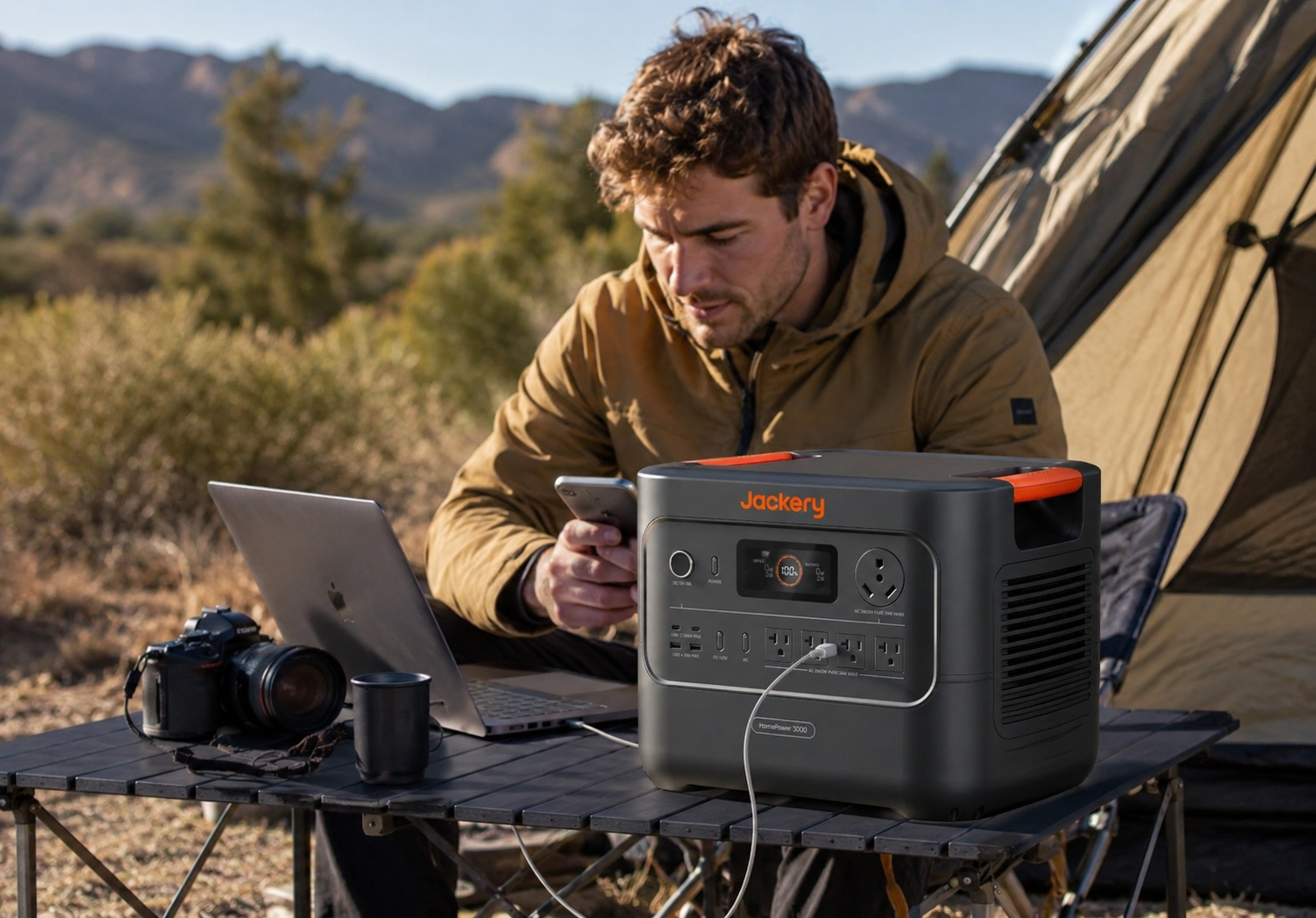
The people who genuinely benefit from a HomePower 3000: full-time van and RV folks running real loads (12V fridge, Starlink, occasional induction cooking, power tools), homeowners in storm-prone regions who need essential-circuit backup for multi-day outages, and remote workers in areas where the grid flickers and takes their desktop with it. The TT-30 RV port is the giveaway that Jackery designed this with rigs in mind, not just car campers.
The people who don’t need this: weekend campers who just charge phones and a laptop (way overkill, look at something around 1000Wh), folks trying to run a whole house including AC (you need a generator or a Power Pro), and ultralight backpackers (this is 63 pounds, come on).
The CTB Thing Is Actually a Big Deal
Jackery is making a lot of noise about CTB — Cell-to-Body — architecture. Normally I roll my eyes at this kind of marketing but in this case it actually matters for anyone living in a vehicle.
Old power stations had cells inside a battery pack inside an outer shell. Three layers. The HomePower 3000 integrates the LFP cells directly into the structural frame, same approach Tesla and BYD use in EVs. Result: significantly smaller than the older Explorer 3000 Pro, and meaningfully lighter than comparable 3kWh units from other brands.
I had a buddy bring his Explorer 3000 Pro to a meetup outside Moab in March. We put them side by side. The HomePower 3000 looks almost embarrassingly compact next to it. In a van where every cubic inch of storage is contested real estate, this is the difference between “fits in the bench cabinet” and “lives on the floor where I keep stubbing my toe on it.”
The honeycomb-style bottom shell is a nice detail too. Adds rigidity. My older unit developed weird flex in the case after about a year, this one feels like it’ll still be solid in five.
The Specs Worth Knowing
| Spec | Value |
|---|---|
| Capacity | 3072 Wh |
| Continuous output | 3600W |
| Surge | 7200W |
| Chemistry | LFP (LiFePO4) |
| Cycle life | 4,000 cycles to 70% |
| UPS switchover | ≤20ms |
| AC charge time | ~2.2 hrs full, ~1.6 hrs to 80% |
| Solar input | Up to 400W |
| Weight | ~63 lbs |
| AC outlets | 4 |
| USB-C PD | 2 × 100W |
| RV port | TT-30 (120V/30A) |
The numbers that actually changed my life: 3600W continuous (I can run anything I own without worrying about overload trips), the 20ms UPS (more on that in a minute), and the AC charge speed.
That AC charging speed in particular. My old unit took six-plus hours to fully recharge from a wall outlet. I’d pull into a campground with shore power, plug in for the afternoon, and leave half-charged. With this thing I can stop for lunch and leave with a full battery. Changes how you plan trips in ways that are hard to articulate until you experience it.
What I Actually Run (Real Use, Not Spec Sheet Math)
People always ask me how long this thing runs X appliance. The honest answer is “depends on a dozen things.” But here’s what my actual days look like, give or take.
Daily van setup: Dometic CFX3 55 fridge running 24/7, MacBook Pro 16” plus a portable monitor for work, Starlink Mini, LED interior lights, and phone/camera charging. Total daily consumption roughly 1800-2000 Wh, which is something like 60-65% of capacity. With two SolarSaga 200W panels on the roof in decent weather, I can run a positive power budget without ever plugging into shore power. That’s the holy grail and this setup actually delivers it.
Cooking day: Same baseline plus three meals on a 1400W induction burner. Probably another 350-400 Wh on top. Still finishes the day with capacity to spare if the sun cooperated.
Heavy day: Hair dryer (yes, my partner uses one, no I don’t want to fight about it), induction cooking, running a small shop vac to clean up sand from the door wells. The 3600W continuous rating handles anything single-appliance, and the 7200W surge has never tripped on me even when I’m running a compressor that pulls something like 3000W on startup.
Here’s a real moment from a couple weeks ago — running a toaster oven at 360°F off the HomePower 3000 in my partner’s kitchen, screen showing 562W input from the wall, 707W output to the oven, battery sitting at 82%. The math is exactly what you’d expect: the unit’s pulling enough from the wall to cover the oven plus a bit of trickle charge to the battery, all while displaying everything clearly on the front panel.
That kind of real-time visibility is genuinely useful. You stop guessing about what’s pulling what.
The Ice Storm Test
The real-world stress test happened in March. My partner lives outside Asheville. There was a freak ice storm that knocked out the grid for somewhere around 30 hours. I drove the van over and we ran her place off the HomePower 3000.
What we ran: standard kitchen fridge (cycles on and off, averages maybe 150W), modem and WiFi router, a couple of phones, one LED floor lamp, a heated blanket on low overnight, and the microwave for short hot-water bursts. We made it more than a full day on a single charge before grid power came back. We weren’t trying to ration aggressively, just being reasonable.
That’s the marketed runtime and that’s what I got. No funny business.
If the outage had gone longer, the two SolarSaga panels would have kept us going indefinitely. We didn’t need to deploy them because the storm was Thursday and the sun came back Friday afternoon.
The 20ms UPS — Yes, I Actually Tested It
I’m enough of a nerd that I wanted to verify the UPS claim. Plugged my desktop into the HomePower 3000 with the unit in pass-through mode, ran a stress test on the CPU, then yanked the wall plug. PC didn’t blink. Tried it five times in a row. Five times, no reboot, no flicker, monitor stayed lit.
For context, an older EcoFlow Delta I owned had something around a 30ms switchover. That extra 10ms was enough to crash my desktop maybe one time in three. The HomePower 3000’s 20ms is the real deal, UL-certified, and I’d genuinely buy this unit for that feature alone if I worked from home in an outage-prone area. A standalone UPS that handles 3600W loads costs more than this entire power station.
People for whom this matters more than they realize: anyone with a desktop PC, anyone running a NAS, security camera setups, aquarium owners, people with medical equipment (though always always have a backup plan, don’t bet your life on any consumer product). Also: smart home hubs that get cranky when they lose power for half a second.
The pass-through mode is what makes the UPS feature work. You leave the unit plugged into the wall, your devices plug into the unit, and if grid power drops, the battery kicks in fast enough that nothing notices.
Charging in the Real World
The advertised “1.7 hours to full via hybrid AC + solar” is technically true but requires conditions that don’t exist most of the time — direct noon sun, perfectly clean panels, low ambient temp. In actual use I see something more like two hours hybrid on a good day. Not a complaint, just calibrating expectations.
Pure AC charging at 1800W input is exactly as advertised. I’ve timed it more than once and the numbers match: roughly 1.6 hours to 80%, full charge a bit past two hours. Faster than any other unit in this capacity class that I’ve personally tested.
Solar charging with two SolarSaga 200W panels varies a lot. Best day I ever logged was somewhere north of 320W input in the desert with the panels at a good angle. Worst day was maybe 40W on a heavily overcast afternoon in the Pacific Northwest. Average across six months of real use, in mixed conditions, somewhere around 180-220W when the sun is up. That’s enough to offset daily consumption in most situations.
The bifacial design on the SolarSaga panels does help when you’ve got a light-colored surface underneath — snow, sand, light gravel reflects extra light onto the back of the panel and adds maybe 10-15% to the input. It’s a real effect, not marketing nonsense, but it’s also not going to transform your power situation by itself.
The Comparison Question
People ask which other units I’d consider in this price range. Honest answer: not many.
The EcoFlow Delta 2 Max is 2048 Wh and 2400W output. Smaller, lighter, decent app, but you’re trading away a third of the capacity and a thousand watts of headroom. If you don’t actually need 3kWh, it’s a fine choice. If you do need it, you’re going to regret going smaller.
The Bluetti AC200L is also 2048 Wh, similar position to the Delta 2 Max. Bluetti makes solid hardware but their app and ecosystem still feel a step behind both EcoFlow and Jackery.
The older Jackery Explorer 3000 Pro is the same capacity as the HomePower 3000 but bigger, heavier, no UPS, no CTB architecture. The HomePower 3000 is just the better-evolved version of the same machine. Unless you find an Explorer 3000 Pro at a steep clearance, there’s no reason to pick it.
Anker’s SOLIX F3000 is in the same general ballpark capacity-wise. Solid alternative, slightly larger footprint, ecosystem isn’t quite as established for solar pairing. I’d put it second on my list after the HomePower 3000.
The Honest Downsides
I said this was an honest review so here are the things I’d change if I could.
The fan. When I’m running the induction burner at full blast, the fan kicks on with a noticeable hum. Not loud-loud, not jet-engine, but in a quiet van at night you’ll hear it. Under light loads — fridge plus laptop plus router — it’s essentially silent.
The app drops Bluetooth more than it should. Probably once every couple of weeks I have to force-quit the app and reopen it to get the connection back. WiFi mode is more reliable but obviously requires internet, which is not always available when you’re parked in BLM land in the middle of nowhere. Firmware update should fix this and I keep hoping the next release will be the one.
Cold weather charging slows down a lot. This is true of all LFP batteries — chemistry won’t accept fast charging when the cells are cold — but worth knowing if you camp in winter. I was in Montana in January and the unit slowed charging significantly when the cabin temperature dropped below 40°F. Not broken, just being protective. If you winter camp, plan to keep the unit somewhere it stays above freezing.
The handles work but aren’t great. At 63 pounds you really want grippy, ergonomic handles. The integrated handles are functional but I sometimes find myself wishing for a bit more contour.
The ZeroDrain Thing Is Underrated
I left the HomePower 3000 fully charged in a storage unit for four months last summer while I was on a trip overseas. Came back, plugged it in to check, it was sitting at 91%. That’s wild. Most batteries in this category would have drifted down to 60-70% from parasitic drain.
This matters more than people realize if you’re using this thing as emergency home backup. You want to know that when the grid goes down twelve months after you bought it, the battery is still ready. ZeroDrain is the feature that makes that true.
The Money Question
The MSRP on this thing is $2,499. At full price, I’d still recommend it but I’d grumble. At the current sale price hovering around $1,169 on Amazon, it’s not really a hard decision. That’s about half of MSRP and significantly less than the EcoFlow and Bluetti competitors at lower capacities.
Five-year warranty is included, which matters because power stations are expensive enough that you want the company to still exist when something breaks. Jackery has been around since 2012, they’re not vanishing tomorrow.
If you’re going to pull the trigger, grab it on Amazon here. The sale price isn’t going to last forever and I haven’t seen a better deal on a 3kWh LFP unit in the last two years of watching this category.
Six Months In, Would I Buy It Again
Yeah. Without hesitation.
The HomePower 3000 is the first power station I’ve owned where I’m not already planning what to replace it with. The LFP chemistry should outlast my current van by years. The UPS replaces a separate piece of equipment that would have cost me hundreds. The charging speed has changed how I plan trips. The CTB architecture means it actually fits in the storage space I have, not “almost fits” or “fits if I move other stuff around.”
Is it perfect? No. The fan and the app are real annoyances. But these are the kind of complaints you have about a product you actually like, not about a product that’s letting you down.
If you’ve been on the fence about a 3kWh-class power station, this is the one. If you have specific questions about my setup or use cases I didn’t cover, drop them in the comments — I read everything.
Stay charged out there.
Heads up: there are Amazon affiliate links in this post. If you buy through them I get a small percentage at no extra cost to you. Doesn’t influence what I write about — I bought my own HomePower 3000 at full retail before any of this.