Disclosure: This post contains affiliate links. I may earn a small commission at no extra cost to you if you purchase through these links.
The 1000Wh portable power station category is absolutely packed right now. Every brand has one. Half of them are basically the same unit wearing a different sticker. So when something actually stands out, it’s worth talking about.
The OUPES Mega 1 caught my attention because it does something the rest of this category mostly refuses to: a 2000W inverter in a 1024Wh body, 80% charge in 36 minutes, under $400 on sale. A weird combination, in the best way.
I’ve spent real time with this unit — running it through camping loads, testing it as a home UPS backup, comparing it against other units I’ve reviewed in this class. Here’s what I found.
Why the OUPES Mega 1 Is Worth Taking Seriously
Most 1000Wh stations top out at 1000–1500W of AC output. Fine for laptops, lights, fans, phone charging. But it means constant mental gymnastics over whether your coffee maker, induction plate, or power tool is about to trip the unit.
The Mega 1 skips that question entirely — 2000W continuous, 4500W surge. Real appliances, not just devices. Induction cooktops, blenders, electric kettles, small power tools, all fine. That surge rating matches units far larger and far more expensive.
Then there’s the charging speed. 36 minutes to 80% on AC alone. 26 minutes combining AC and solar. Not a typo. Most units in this capacity class take 1.5 to 2.5 hours to hit 80%. OUPES cut that down to a third.
For van life and camping, that changes how you actually use the thing. Roll into a campground with hookups in the afternoon, top off in under an hour, spend the night off-grid without wondering where tomorrow’s power comes from.
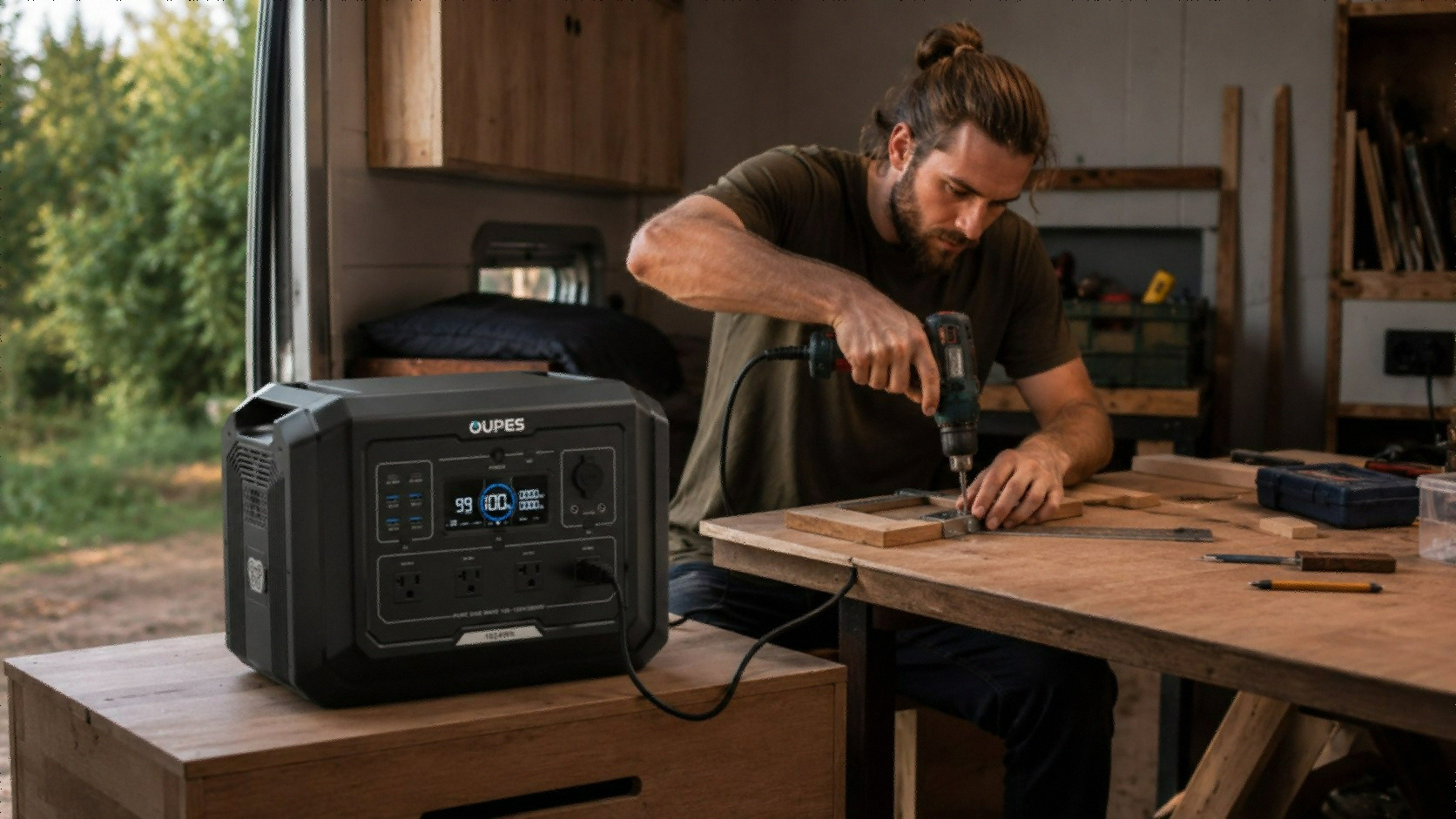
Full Specs: OUPES Mega 1 1024Wh
| Spec | Value |
|---|---|
| Capacity | 1024Wh |
| AC Output | 4 outlets, 2000W continuous (4500W surge) |
| USB-C Output | 2x 100W PD |
| USB-A Output | 4x 18W QC3.0 |
| DC Output | 2x DC5521, 1x car socket 12V/10A |
| Solar Input | Up to 600W |
| AC Charging (0–80%) | 36 minutes |
| AC + Solar Combined | 26 minutes to 80% |
| Battery Chemistry | LFP (LiFePO4) |
| Cycle Life | 3500+ cycles to 80% capacity |
| UPS Transfer Time | Less than 20ms |
| Expandable Capacity | Up to 5120Wh (with 2x B2 extra batteries) |
| Weight | 27.8 lbs |
| App Control | Bluetooth |
| Total Outputs | 13 ports |
27.8 lbs deserves its own line. That’s genuinely portable — one-hand carry. Next to the 99-lb DELTA Pro, or even the 62-lb units in the 2000–3000Wh tier, the Mega 1 is something you toss in a trunk, walk to a campsite, or move around the house without staging a logistics operation.
What Makes the OUPES Mega 1 Different from the Competition
The Charging Speed Story
This is worth dwelling on, because 36-minute 0–80% charging is genuinely unusual. OUPES gets there through a higher-wattage AC input paired with their own fast-charge management system. Practically: a wall outlet for 45 minutes leaves with a nearly full battery.
For comparison, the EcoFlow DELTA 2 — same 1024Wh, direct competitor — does 0–80% in about 50 minutes. Already fast. The Mega 1 beats that by roughly 30%. Add solar into the mix and 26 minutes makes it the fastest charging unit in this size class, full stop.
Related Post: EF ECOFLOW DELTA Pro 3600Wh Review — Van Life and Home Backup
The 2000W Inverter in a 1000Wh Body
Most brands pair a 1000Wh battery with a 1000–1500W inverter — the “safe” ratio that keeps you from draining the battery too fast.
OUPES went a different direction. A 2000W inverter means you can run high-draw appliances that nothing else in this size class can touch. The tradeoff is obvious — run a 1500W electric kettle and 1024Wh disappears fast. But for short bursts — cooking a meal, a power tool for ten minutes, a blender — the Mega 1 just does it.
The 4500W surge rating is what saves you from startup spikes. Motors, compressors, pumps pull 3–5x their running wattage for a split second on startup. Surge rating below that draw, and the unit trips. At 4500W, the Mega 1 shrugs off basically anything you’d realistically plug in while camping or running home backup.
LFP Battery and 3500+ Cycle Life
Like the better units in this class, the Mega 1 runs LiFePO4 chemistry:
- 3500+ charge cycles to 80% capacity (vs. 500–800 for cheaper NMC units)
- Stable across temperature extremes
- No thermal runaway risk
- Capacity holds steady over years, not months
One cycle a day, 3500 cycles works out to roughly 9.5 years before the battery drops below 80%. For a $400 unit, that’s exceptional. A cheaper NMC unit at the same price might need replacing in 2–3 years under heavy use.
UPS Mode with Sub-20ms Transfer
This is the feature most people ignore until the day they need it. Plug your critical devices into the Mega 1, plug the Mega 1 into the wall. Normal conditions, everything runs on wall power. Grid drops, the Mega 1 switches to battery in under 20 milliseconds.
Most computers and sensitive electronics tolerate up to about 30ms of interruption without resetting or losing data. Sub-20ms means your laptop doesn’t even flicker. It just keeps running.
For home backup, that’s the whole point — set it up once, forget about it until you need it.
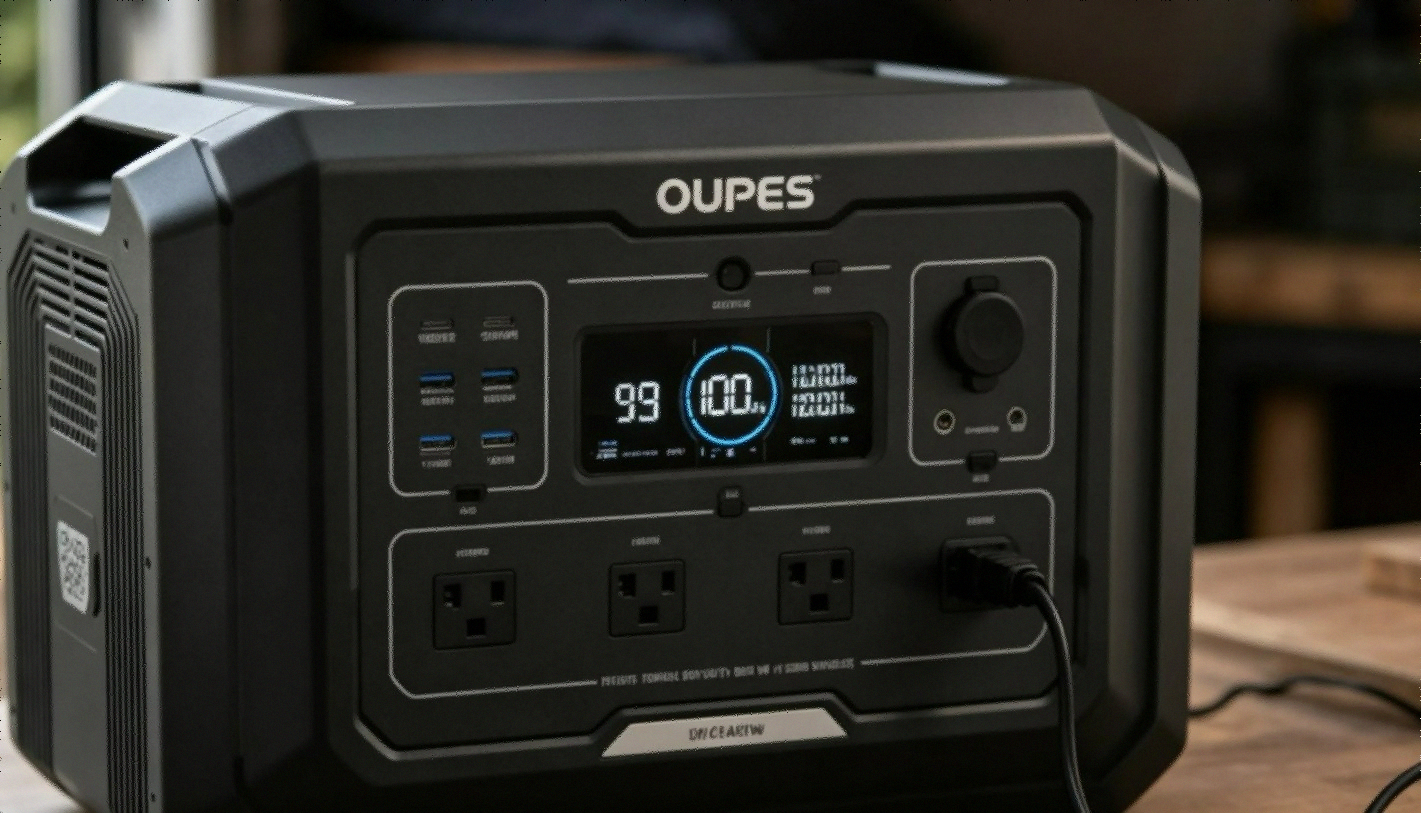
Real-World Camping Performance
A realistic daily load for camping with the Mega 1:
| Device | Wattage | Daily Hours | Daily Wh |
|---|---|---|---|
| Small 12V compressor fridge | ~40W avg | 24h | ~960Wh |
| Laptop | 45W | 6h | 270Wh |
| Phone + tablet charging | 30W | 2h | 60Wh |
| LED lights | 15W | 4h | 60Wh |
| Fan | 25W | 8h | 200Wh |
| Total | ~1550Wh |
At that load, 1024Wh lasts roughly 16 hours — basically one overnight cycle before a recharge. Add a 200W solar panel and 5–6 hours of sun gets you close to 1000Wh back, nearly covering the day.
Where it really shines is the burst-cooking scenario. Run an induction cooktop at 1500W for 20 minutes to make dinner, that’s about 500Wh gone. The Mega 1 handles it without complaint (2000W continuous), and you can put that 500Wh back in under 20 minutes if you’ve got AC hookups.
Multi-day trips without hookups come down to your solar setup. With 400–600W of panels — the Mega 1’s max input — expect roughly 1500–2500Wh of recovery on a good Southwest day. That covers typical camping loads with room to spare.
💡 Pro Tip: OUPES allows expansion to 5120Wh by connecting two B2 extra batteries. No inverter upgrades, no complex wiring — they snap on. If you start with the Mega 1 and find you need more capacity, you don’t have to start over.
Home Backup Use: How Long Does It Last?
At 1024Wh with 2000W output, here’s what the Mega 1 realistically covers for home backup:
Refrigerator only (150W average): ~6–7 hours runtime
Critical devices only (fridge + laptop + phone charging + lights): 3–4 hours
Full kitchen appliances (microwave, coffee maker, fridge): 1–2 hours with burst cooking
For a short outage — 4 to 8 hours — 1024Wh comfortably covers the essentials, or keeps medical equipment, laptops, and lights running through a full night.
If you need multiple days of backup for heavy appliances, the Mega 1 on its own isn’t the tool for that. That’s DELTA Pro territory. But for the outages most people actually deal with — storms, grid maintenance, brief brownouts — 1024Wh in UPS mode is genuinely useful coverage.
Related Post: Best Solar Generator for Home Backup and Camping Portable 2026
⚠️ Watch Out: One reviewer noted actual capacity running lower than rated specs under certain conditions. Fairly common across all portable power station brands — rated capacity is measured at specific temperature and discharge rates. Expect 85–95% of rated capacity in the real world, not 100%.
OUPES Mega 1 vs. The Competition See Today’s Deal on Amazon
How it actually stacks up against the closest alternatives:
| Model | Capacity | AC Output | Surge | Charge Speed (0-80%) | Weight | Price |
|---|---|---|---|---|---|---|
| OUPES Mega 1 | 1024Wh | 2000W | 4500W | 36 min | 27.8 lbs | ~$400 |
| EF ECOFLOW DELTA 2 | 1024Wh | 1800W | 2700W | ~50 min | 27.2 lbs | ~$399 |
| Anker SOLIX C2000 Gen 2 | 2048Wh | 2400W | 4800W | ~60 min | 49 lbs | ~$799 |
| Jackery Explorer 1000 v2 | 1070Wh | 1500W | 3000W | ~60 min | 23.1 lbs | ~$599 |
The advantages are clear: highest AC output in the 1000Wh class, charge time well ahead of everyone else, competitive pricing. The Jackery is lighter, but 1500W can’t keep up with the same appliances. The DELTA 2 is a worthy competitor but loses on both output and speed.
The 13 Outputs: Actually Useful or Just Marketing?
OUPES advertises 13 outputs, and unlike brands that pad the count with duplicates, these are genuinely useful:
- 4x AC outlets (120V, sharing the 2000W pool)
- 2x USB-C (100W PD each)
- 4x USB-A (18W QC3.0 each)
- 2x DC5521 (12V)
- 1x Car socket (12V/10A)
The 100W USB-C ports stand out. A lot of units this size still ship with 65W or lower. 100W fast-charges a MacBook Pro directly, no adapter, or runs a small monitor. Real difference for anyone working mobile.
The car socket lets you run 12V vehicle-spec gear directly — tire inflators, car-spec coolers, camping accessories built for that voltage.
Keeping every port and the display on the same face sounds minor, but it matters in practice. No rotating the unit just to check status or plug something in.
What Real Users Are Saying
1,093 Amazon reviews, averaging 4.6 stars, and the patterns hold up.
People are genuinely impressed by the charging speed — multiple reviewers mention near-zero to full in under an hour, one Canadian reviewer clocking 35 minutes for 0–100%. The 2000W output gets praise for handling appliances that other 1000Wh units choke on: induction cooktops, coffee makers, power tools.
Portability comes up again and again. At 27.8 lbs with carry handles, most adults move it without help — trucks, cargo vans, travel trailers, apartments.
The more critical reviews land on two points. Some users report actual runtime below rated specs, which — as already noted — is common across brands depending on temperature and discharge rate. And the manual is rough, machine-translated English, an OUPES brand-wide issue rather than something specific to this unit.
One reviewer who truck camps with it described running a fridge, laptop, drone chargers, lights, and an espresso maker for multiple days with solar top-offs. That’s about as real-world an endorsement as this use case gets.
Expandability: Growing With Your Needs
What I genuinely like here is the modular expansion. Buy it today, decide in six months that 1024Wh isn’t enough, and you don’t replace the unit — you add a B2 battery. Two of them brings total capacity to 5120Wh, roughly 5x base.
No extra inverters. No rewiring. They snap on.
That matters for two reasons. It protects what you already spent — no tossing a perfectly good $400 unit because your needs grew. And it means buying exactly what you need now, scaling later, instead of overpaying upfront for capacity you might never use.
For the van life crowd that starts with weekend trips and eventually goes full-time, this is the kind of flexibility that actually makes sense.
Who Should Buy the OUPES Mega 1
This is a strong buy if:
- You want serious 2000W output in a genuinely portable (under 30 lb) package
- Charging speed matters — you need to top off quickly between uses
- You want UPS home backup protection for critical devices
- Budget is real and $800+ for a 1000Wh unit isn’t happening
- You might expand capacity later without buying a whole new system
- You’re camping 1–3 nights and want to run real appliances, not just charge phones
Look elsewhere if:
- You need more than 1024Wh base capacity and can’t wait to add batteries
- Your main use case is whole-home backup for days at a stretch (step up to 3600Wh+)
- You specifically need 240V output for high-voltage tools or appliances
- You need solar passthrough above 600W for rapid outdoor recharging
Frequently Asked Questions See Today’s Deal on Amazon
How fast does the OUPES Mega 1 actually charge? OUPES claims 0–80% in 36 minutes on AC alone, 26 minutes combining AC and solar. Real-world reports back up the AC-only number, with some users measuring full 0–100% charges in under an hour.
Can I use the OUPES Mega 1 while it’s charging? Yes. UPS mode is built for exactly this — devices run off wall power through the Mega 1 while the battery stays topped up. Grid fails, it switches to battery in under 20ms.
How many extra batteries can I connect? Up to two B2 batteries, taking capacity from 1024Wh to 5120Wh. No additional inverter required.
Is the OUPES Mega 1 compatible with any solar panels? It accepts up to 600W solar input. Most standard panels work — just check that your panel’s voltage and current fall within the Mega 1’s input specs first.
How does OUPES customer support compare to larger brands? OUPES offers a 6-year warranty with product registration (one reviewer flagged this specifically). Customer service is generally reported as responsive, though the technical documentation lags behind brands like EcoFlow.
Is 1024Wh enough for van life? Depends on the load. Light use — laptop, phone charging, LED lights, small fan — and 1024Wh comfortably covers a night or two without recharging. Run a compressor fridge 24/7 and you’ll want solar top-up or the B2 expansion batteries for multi-day off-grid stretches.
Final Verdict
The OUPES Mega 1 does something most competitors won’t: real inverter muscle — 2000W continuous, 4500W surge — in a 1000Wh body, 80% charge in 36 minutes, under $400. That combination is rare.
It’s not perfect. The documentation is rough. Real-world runtime lands slightly below rated specs, same as every unit in this category. It’s not a whole-home backup solution by itself.
But as a genuinely portable, fast-charging, high-output station for camping, van life, road trips, and short-duration home backup, the Mega 1 is one of the stronger value plays in the 1000Wh class right now. 1,093 Amazon reviews averaging 4.6 stars across a wide range of use cases back that up.
Current pricing: Check the latest price on Amazon — frequently discounted during Prime events. The current Prime Day price of $399.99 (down from $549) is a strong entry point if you’ve been watching this category.
Amazon Associates disclosure: As an Amazon Associate I earn from qualifying purchases. This does not affect the price you pay or my editorial opinions.