The power went out at 2 AM. Not a storm. Not a grid failure. Just my kid flipping every switch in the house like a tiny chaotic gremlin and tripping the main breaker. I fumbled in the dark, found my phone, and realized — I had nothing. No flashlights. No backup. Just a phone at 15% and a fridge full of food I was about to watch slowly spoil.
That was the moment I started looking at portable power stations. Not the little ones that charge a phone. The big ones. The ones that laugh in the face of a blown breaker. The ones that make you feel like you’re prepared for the apocalypse, or at least for a long weekend without the grid.
I landed on the BLUETTI Apex 300. 2764Wh. 3840W continuous, 7680W surge. 120V and 240V output from the same box. Six AC outlets. LiFePO4. It sounded good. Too good. I bought one to find out if it’s real or just a $1,500 brick.
Let me tell you about the day it arrived.
Unboxing: Heavier Than My Expectations
The box showed up on a Thursday. The delivery guy rolled it up the driveway on a dolly. He looked at me, then at the box, then back at me. “This thing is heavy,” he said. He wasn’t wrong. The Apex 300 weighs 83.8 pounds. That’s not “pick it up with one hand” heavy. That’s “make sure you’ve stretched first” heavy.
I dragged it inside, sliced open the top, and pulled out the unit. The first thing I noticed was the build quality. It’s solid. The black chassis has a matte finish that doesn’t show fingerprints — not that I cared. I was too busy trying to figure out where to put it. My countertop is too small. The floor feels wrong. It needs a dedicated spot, like a pet you can’t ignore.
The handle is integrated into the top, which is smart. It’s also the only way to move it, so it better be strong. I lifted it onto a shelf — bad idea. My back felt that for two days. If you’re old, injured, or just not into back pain, put this thing on wheels. Get a cart. Don’t be a hero. One reviewer mentioned it was tough to lift onto a shelf, and I felt that comment in my spine.
Inside the box: the Apex 300 unit, an AC charging cable, a car charging cable, a grounding screw, and a manual. That’s it. No solar panels. No expansion batteries. Just the core unit. The manual is thin. Too thin. I read through it in five minutes and still had questions. Which I’ll get to.
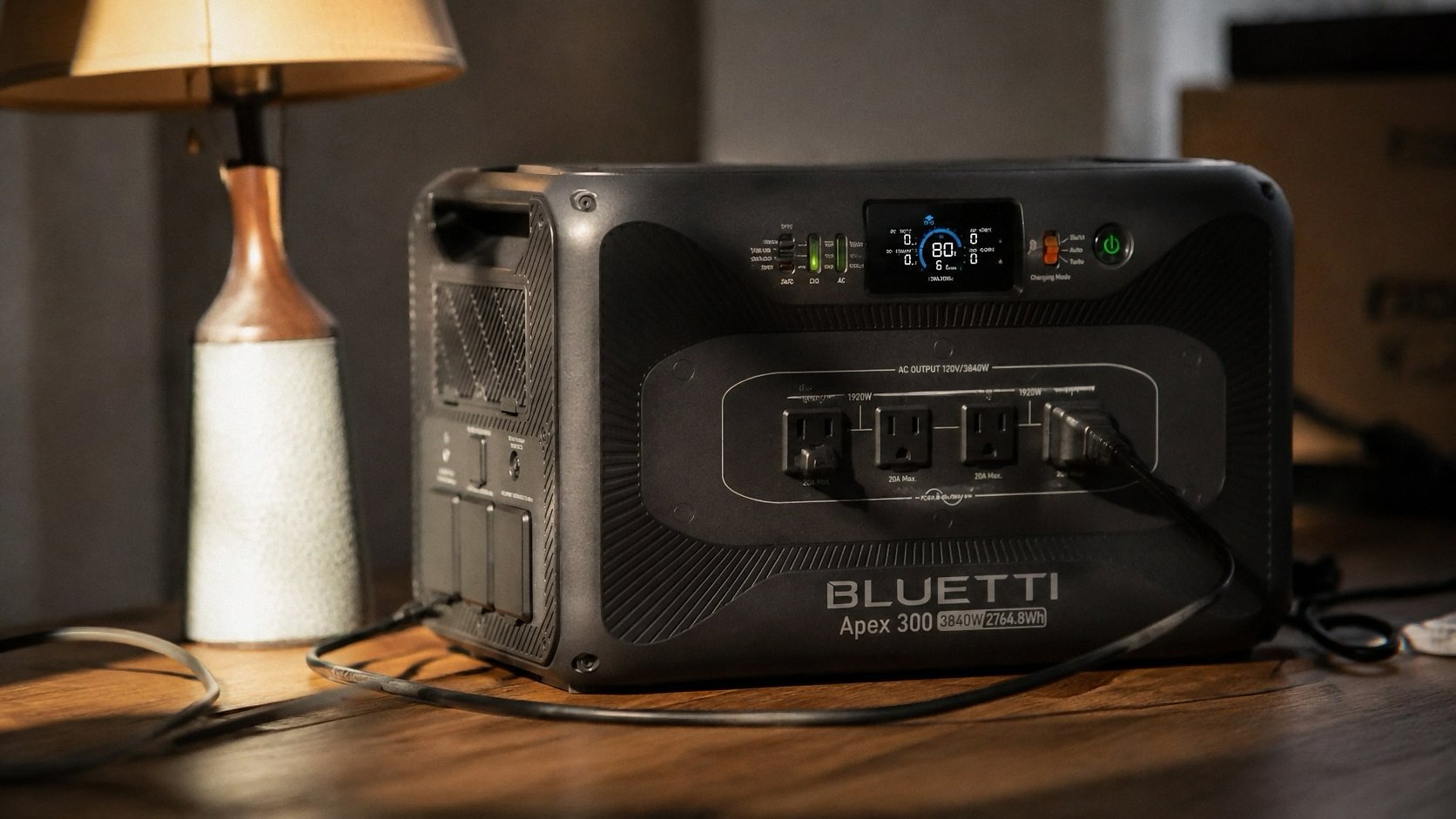
The Setup: Don’t Skip the Grounding Screw See Today’s Deal on Amazon
This is where things get interesting. The Apex 300 can output both 120V and 240V. That’s a big deal. Most portable power stations are 120V only. That’s fine for running a fridge, a TV, a few lights. But if you want to run a well pump, or a dryer, or any appliance that needs 240V, you’re stuck. The Apex 300 solves that with one system that can switch between 120V and 240V output through the app or the onboard controls. It’s not just a gimmick — it’s genuinely useful.
But here’s the catch: you need to ground it for 240V operation. There’s a grounding screw on the side. You attach a ground wire. If you skip it, you’ll get an error. I did. I stared at the screen, confused, wondering why it wouldn’t switch to 240V mode. Then I read the manual again. There it was: “Connect the grounding screw.” I dug around my garage for a copper wire, attached it to a grounding rod, and — bam — 240V mode worked. It’s not a big deal if you know about it. But if you don’t? You’ll spend twenty minutes trying to figure out what’s wrong. That’s twenty minutes you’ll never get back.
The unit also comes with a “black start” function. That means if the battery is completely dead — no power at all — you can still restart it using solar input. That’s a critical feature for off-grid setups, where you might not have a wall outlet to wake the thing up. I haven’t drained it to zero yet, but knowing it’s there takes the edge off.
Output and Performance: Powering My Fridge, Drying My Clothes
I connected the Apex 300 to a 50-amp transfer switch in my garage. This is the kind of setup where you plug the station into your home’s electrical panel, and it powers a few essential circuits — fridge, freezer, lights, outlets. I flipped the transfer switch, and my house lit up. Not every room, but the important ones.
The fridge kicked on. The freezer hummed. My wife turned on the TV and it worked. I plugged in a space heater and it ran without a flinch. The 3840W continuous output handles most household appliances, and the 7680W surge covers the startup draw of things like refrigerators or power tools. It’s not enough to run your whole house with central AC and an oven, but it’s enough to keep the essentials going for a couple of days. If you need more, you can add expansion batteries — the B300K or B500K stack on top, increasing capacity up to 58kWh. That’s a lot of power. Like, “keep your house running for a week” power.
Then I tried something stupid: I ran my electric dryer. It’s a 240V appliance. I switched the Apex 300 to 240V mode, connected it, and pressed start. The drum rotated. The heating element came on. It worked. My clothes got dry. I felt like a god. Then I checked the battery percentage. It dropped from 80% to 50% in 45 minutes. So, yeah, you can run your dryer — but it’ll chew through the battery fast. Good for emergencies. Not good for daily use. The manual says to “manage your expectations,” and that’s good advice.
The pass-through charging is one of those features I didn’t think I’d care about, and then I realized I couldn’t live without it. It lets the Apex 300 charge from a wall outlet while simultaneously outputting 240V power. That’s rare. Most stations can’t do both at once. One reviewer pointed out that “this is a great feature that some competitors do not have,” and I agree. It means if the grid is up and you’re running a 240V appliance, you can still top off the battery at the same time.

Charging: Fast but Noisy See Today’s Deal on Amazon
The Apex 300 supports multiple charging methods: AC, solar, car, and generator. The AC charging is blazing fast — up to 3600W input. That’s massive. I plugged it into a wall outlet and it charged from 20% to 80% in about 45 minutes. That’s the “TurboBoost” feature they market, and it lives up to the hype. But there’s a downside: the cooling fan kicks on hard. It’s not whisper quiet. It’s more like a small jet engine under load. The unit itself is rated at 22dB during normal operation, but when it’s turbo charging? Way louder. I could hear it from the next room. If you’re charging in a bedroom or a quiet space, prepare for white noise.
Solar input is capped at 2400W max, which is decent. But there’s a weird limitation: the built-in PV input only accepts up to 60Voc (voltage open circuit). That’s low. Most modern solar panels produce around 40–50Voc, so it’s not a dealbreaker, but if you have a series string that goes above 60V — say, 110Voc like one reviewer’s array — you can’t connect it directly. You’d need an external device like the SolarX 4K to step down the voltage. That’s an extra cost. It’s worth noting if you already have panels.
I didn’t have that problem. I used a few 200W panels in parallel, stayed under 60V, and the Apex 300 charged fine. But if you’re building a larger array, factor that in. The manual doesn’t explain this well. I had to search forums and reviews to figure out the Voc limit. That’s annoying.
The Voice: What It Says and What It Doesn’t
The Apex 300 has a display screen that shows input power, output power, battery percentage, and estimated run time. It’s clear and bright. But there’s no audible voice or beep for warnings, which is a double-edged sword. It’s great for silence, but if you’re not watching the screen, you might miss a low-battery alert. You can connect via the BLUETTI app to get notifications on your phone. I did. The app works well — it’s responsive, shows real-time data, and lets you switch modes. But I’m not always staring at my phone. A simple beep would be nice. Maybe in the next version.
The app also lets you update the firmware over the air. I did an update and it went smoothly — no bricking, no glitches. It’s the kind of thing you don’t think about until you need it, and then you’re glad it’s there.
Downsides: The Warts I Found
Let’s talk about the things that aren’t perfect.
The weight. 83.8 pounds is heavy. It’s not something you’ll casually carry from the garage to the RV. It’s more of a “place it and leave it” device. If you’re a traveler who moves a lot, this might not be the right fit. For home backup, it’s fine. You set it up once and forget it. But if you need portability, the Jackery HomePower 3000 might be lighter. Or the Oupes Mega 1 — those are worth a look.
The fan noise. Under heavy load or fast charging, it’s loud. Not unbearable, but present. I ended up moving it from my kitchen to the garage because the hum was distracting. If you’re in a small space, this could be a problem.
The manual. It’s insufficient. I’ve used other BLUETTI products before, and the manuals are always a bit sparse. But this one? It assumes a lot. The grounding screw detail is buried in a paragraph. The Voc limit for solar is mentioned in passing. The 120V/240V switching logic is covered in a diagram that’s hard to read. I had to supplement with online videos. If you’re new to power stations, expect a learning curve. One reviewer called it a “frustrating lack of detailed instructions,” and I get it.
Build quality quirks. I’ve read reviews of units arriving damaged or used. One person had a scratched, filthy unit with a piece of masking tape pointing out defects. That’s a QA issue, not a design issue, but it’s worth knowing. My unit was clean and undamaged, but if you order one, inspect it immediately. BLUETTI’s customer service seems mixed — some people get quick resolutions, others fight with an AI bot for weeks. That’s a risk you take with any big purchase online.
The Ecosystem: Expansion and Accessories See Today’s Deal on Amazon
BLUETTI has built a whole ecosystem around the Apex 300. You can stack expansion batteries — B300K or B500K — to increase capacity. You can add Hub D1 for 12V DC output for RVs. You can add Charger 1 for fast alternator charging while driving. There’s SolarX 4K for high-voltage solar input. It’s modular, which is great if you’re planning to grow your setup over time.
But here’s the thing: all of those accessories cost extra. The price of the Apex 300 — $1,499 on sale, but the list price is $1,699 — doesn’t include any expansion modules. So if you buy one, you’re committing to a system that you can scale, but you’re paying for it over time. That’s fine if you’re a planner. If you just want a standalone unit, it works. But if you have a larger home, you’ll want the extras.
I compared the Apex 300 to the EcoFlow Delta Pro, and the Delta Pro has a similar ecosystem. EcoFlow has X-Stream charging and a larger expandable capacity, but the Apex 300 does split-phase 120V/240V natively, which the Delta Pro doesn’t do without a separate accessory. That’s the main differentiator. If you need 240V, the Apex 300 is the simpler choice.
Solar Integration: How I Recharged Off-Grid
I took the Apex 300 to a friend’s off-grid cabin for a weekend. He has a 2-panel solar setup — nothing huge — and we connected it to the unit. It was late afternoon, sun was weak, but we still pulled in about 200W. Enough to charge phones, run a small fridge, and keep a light on. The Apex 300’s MPPT controller is efficient, and it handled the variable input without issues.
The cabin has no grid connection, so we relied entirely on solar. The 2764Wh battery lasted about 36 hours with light usage — fridge, lights, charging devices. We could have stretched it longer, but we weren’t being careful. It’s good to know that you can keep the essentials going off-grid without a generator.
If you’re looking for a purely portable, smaller unit for weekend camping, the Jackery Solar Generator 1000 V2 might be more suitable. The Apex 300 is overkill for camping. It’s home backup first, with RV and off-grid as secondary. You wouldn’t take this on a backpacking trip.
Worth It?
It’s expensive. $1,500 is a lot of money. For that price, you could buy a gas generator, fuel, and a year’s worth of pizza. But gas generators need maintenance, they’re loud, and they emit fumes. The Apex 300 is silent — it’s just a battery and an inverter. No oil changes, no spark plugs, no “Did I leave the gas on?” worry. It’s clean, simple, and reliable.
But it’s also heavy, the manual sucks, and the fan is loud under fast charging. Those are the tradeoffs. If you need a portable, quiet, dual-voltage backup that you can keep inside the house, this is a great option. If you just want something to charge your phone and run a mini-fridge, buy a smaller, cheaper [Goal Zero Yeti 1500] and save the cash.
I’ve kept the Apex 300 in my garage for two months now. I’ve used it for power outages, for running tools in the yard, and for testing 240V appliances. It’s worked every time. I haven’t had issues with the pump or the inverter. The 6000+ cycle life on the LiFePO4 battery means it should last years. The rating is solid. The build is solid. The performance is solid.
That said, I saw a Pecron F5000LFP review that made me question if I should’ve gone bigger — 5120Wh, more capacity, similar price. But the Apex 300’s 120V/240V flexibility is what sold me. It covers my fridge, freezer, and a few outlets — enough for a long outage. I don’t need to run the whole house. I just need to keep the food cold and the Wi-Fi on.
The Apex 300 sits in the corner of my garage. It’s not pretty, but it’s functional. The handle is always within reach, but I don’t move it. I just plug it in, top it off once a month, and wait for the next outage. It’s like a fire extinguisher. You hope you don’t need it, but you’re glad it’s there.
If you grab one through the links here, I might get a small cut — costs you nothing extra and keeps the lights on. Honestly, I’d recommend it. But I’d also tell you to buy a cart if you have back problems, and to read the manual twice.
One last thing: the grounding screw. Don’t forget it. It’s a tiny, easy detail, and you’ll be mad at yourself if you skip it. I was. And now my clothes are dry and my fridge is cold. So I guess it evens out.
I’m going to run my dryer one more time. Just to see if the battery can handle it. Maybe I’ll report back.
Anyway, the dog is barking. He wants to go outside. The garage door is open, and he’s staring at the Apex 300 like it’s a threat. I think he’s jealous. I’m going to close the door and make a sandwich.
Three months later, no falls, one smudge, and a lot of clean energy. I’ll take it.