PECRON F5000LFP Review: The Honest Take Nobody Else Is Giving You
I’ve been deep in the solar generator rabbit hole for a while — tested the Anker SOLIX F3800, spent time with the [Anker SOLIX C2000 Gen 2], wrote up a full roundup of the best solar generators for home backup and camping in 2026. So when the PECRON F5000LFP showed up at $1,999, I had to dig in.
This thing is genuinely interesting. Not perfect. But interesting in ways that matter if you’re shopping around $2,000 for real whole-home backup or heavy RV use.
What Is the PECRON F5000LFP?
PECRON’s flagship home energy storage unit — and I mean “home energy storage” deliberately, because this isn’t a throw-it-in-your-truck portable station. At 123.9 pounds, the wheels aren’t an afterthought.
At a glance:
| Spec | Value |
|---|---|
| Capacity | 5120Wh |
| AC Output | 7200W (continuous) |
| Solar Input | 6400W |
| Voltage | 120V / 240V dual |
| Battery Type | LiFePO4 |
| UPS | 0ms online UPS |
| Weight | 123.9 lbs |
| Expandable To | 35.8kWh (with 6x FP5000-48V batteries) |
| Price | $1,999 |
Competitive numbers on paper. Now what they mean in practice.
Who Actually Needs the F5000LFP?
Before buying anything in this category, be honest about what you’re solving for. Three types of buyers tend to land here:
Type 1: The “Grid Goes Down” Prepper Unreliable power where you live — hurricane country, wildfire zones, rural areas with aging infrastructure. You need the fridge running, the CPAP going, lights on for 2-3 days without thinking too hard about it.
Type 2: The Solar-Forward Homeowner Already have a solar array, or planning one, and want battery storage without a $15,000 whole-home system. Shift peak usage, dodge high electricity rates, eventually go mostly off-grid.
Type 3: The Serious RV/Van Lifer Not weekend camping — full-time or extended travel, running a laptop, fridge, climate control, maybe a CPAP every night.
The F5000LFP is built for all three. Whether it delivers for all three is the actual question this review is answering.
Build Quality and Design: Surprisingly Solid See Today’s Deal on Amazon
PECRON isn’t Jackery. No brand recognition, no YouTube sponsorship saturation, none of EcoFlow’s marketing polish. But the F5000LFP feels well-built.
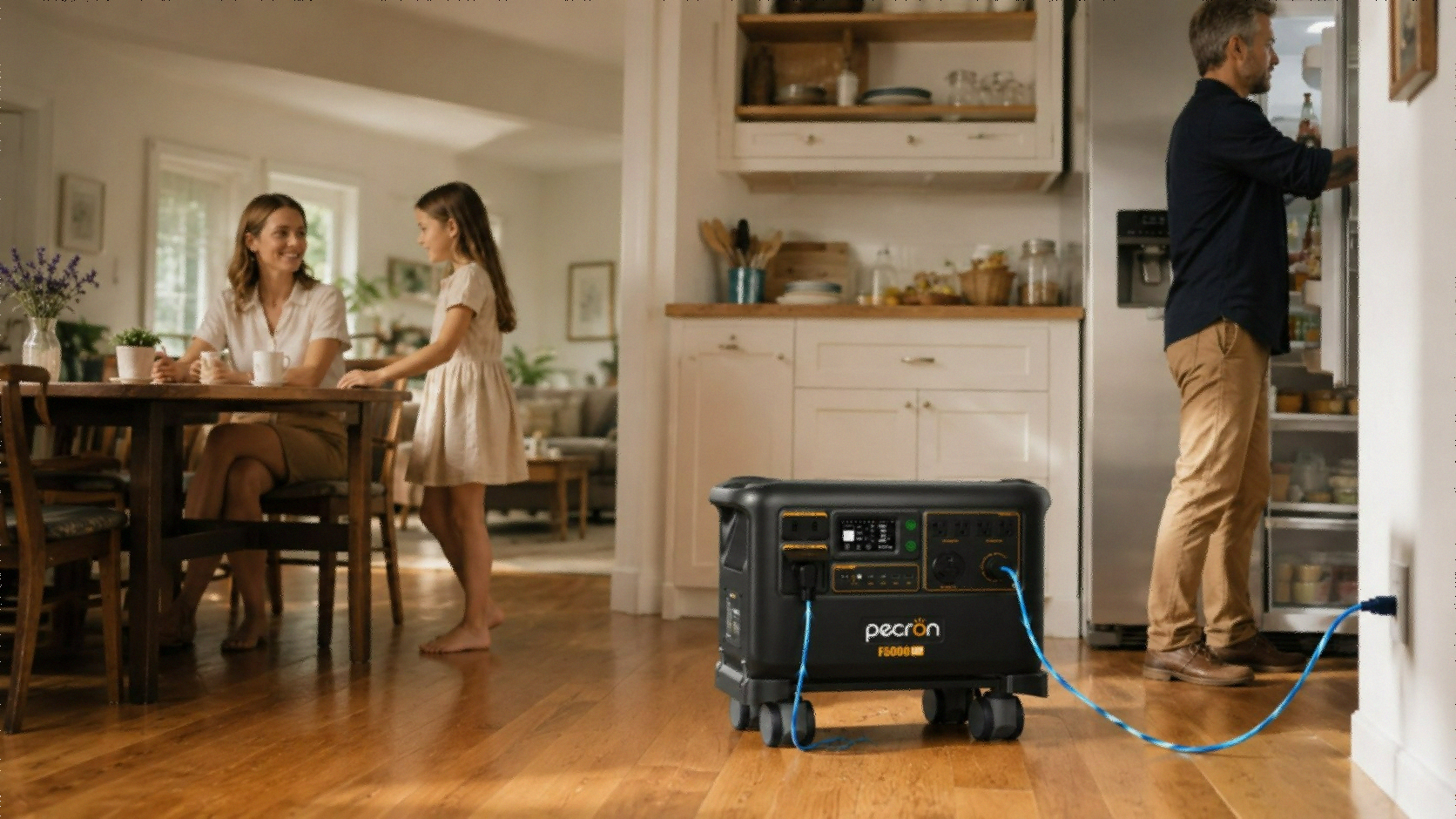
The chassis is dense, substantial. The display is clear. Port layout makes sense — AC outputs grouped, DC outputs in their own section, UPS ports clearly marked. The detachable cart with caster wheels is a smart call. Without it, moving 124 pounds around a garage or up a ramp into an RV would be miserable.
The control panel handles mode switching, charging rate, automation settings without needing the app — appreciated. App dependency is a real problem during power emergencies when your phone’s at 3%.
The app itself exists, works, and is genuinely useful for scheduling and solar priority. More on that below.
Power Output: Does 7200W Actually Deliver?
Here’s where it gets interesting. Most “portable” stations around $2,000 top out at 3,000–4,000W continuous. The F5000LFP claims 7200W.
That matters for real appliances:
- Central air conditioner: 3,000-5,000W
- Electric dryer: 5,000-6,000W
- Water pump: 1,000-2,000W
- Microwave: 1,000-1,500W
- Refrigerator: 150-400W
Fridge, microwave, and a window AC running together is roughly 3,000–4,000W. The F5000LFP handles it without strain. Running an electric dryer during an outage needs the 240V output — which this unit has, via dual voltage. Most competitors at this price don’t offer 240V at all.
That dual voltage is honestly one of the biggest differentiators. Stacked against the Anker SOLIX F3800, the F5000LFP comes out ahead on solar input too — 6400W versus 2400W.
One real-world note: sustained high-draw loads — dryer, water heater elements — drain 5120Wh faster than you’d think. At 5,000W continuous, you’re looking at roughly an hour of runtime. Not a flaw, just physics. For emergency use you’d stagger loads rather than run everything at once.
The UPS Feature: Genuinely Underrated
Most reviews gloss over this: the 0ms online UPS.
Standard home UPS systems have a transfer time — usually 10-20ms between grid failure and battery kicking in. Fine for most devices. For sensitive electronics — networking gear, certain medical devices, servers — that brief gap causes real problems.
The F5000LFP’s 0ms online UPS removes the gap entirely. The battery stays online, always providing clean power. The grid effectively “charges” the battery while power flows through.
For anyone running a home network with multiple devices — one Amazon reviewer mentioned 16 POE security cameras and a WiFi router — this is meaningful. Cameras don’t hiccup on a flicker. The NAS doesn’t throw an error. The CPAP doesn’t restart mid-sleep.
Two 20A and one 30A UPS outlets are on board. Plan accordingly if you’ve got more UPS-critical devices than that covers.
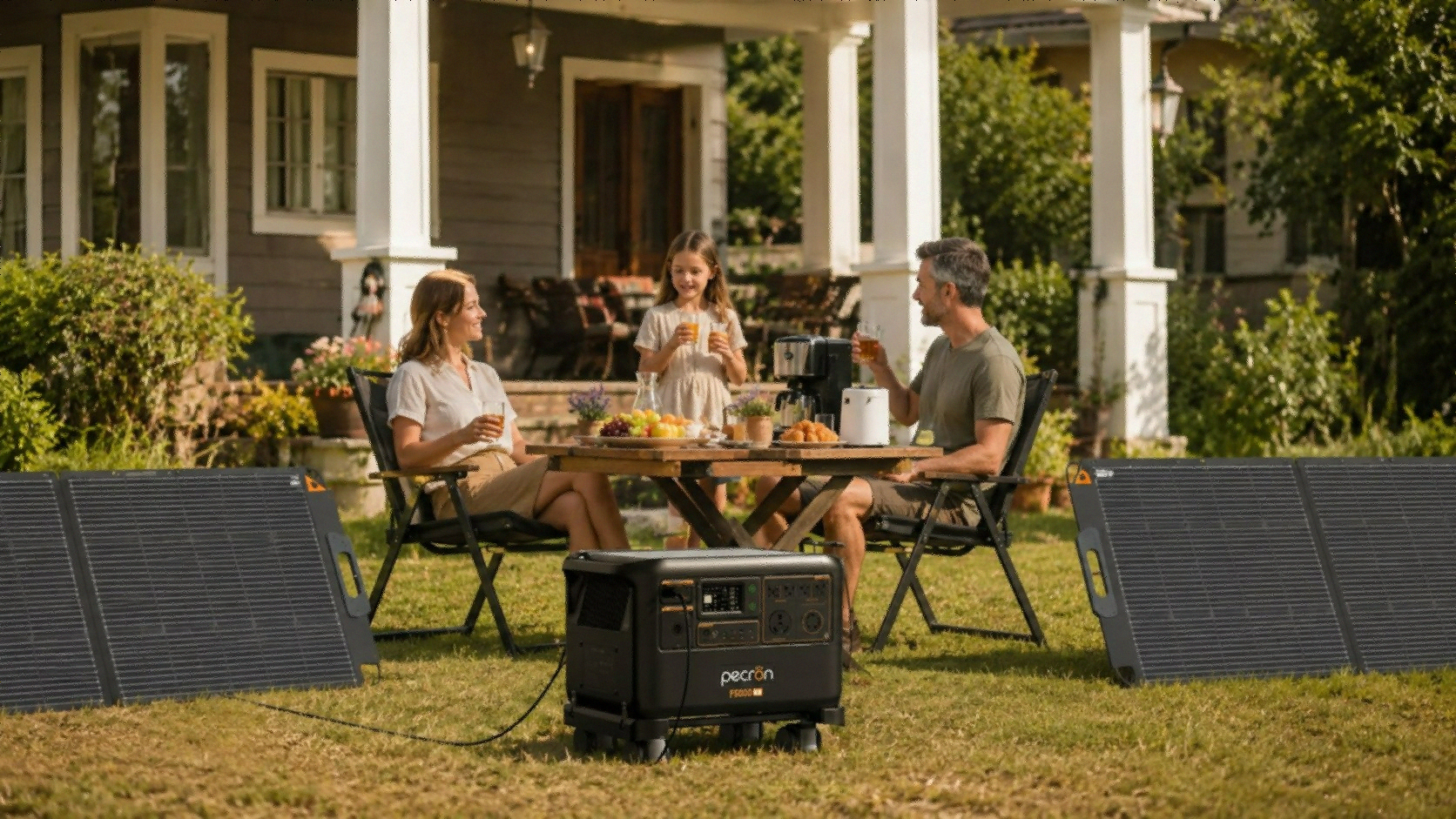
Solar Charging: Where PECRON Gets Serious See Today’s Deal on Amazon
6400W of solar input. Sit with that number for a second.
Most stations in this price range take 800W–1500W of solar. The DELTA Pro accepts 1600W. The Anker SOLIX F3800 goes up to 2400W. PECRON claims 6400W.
Two solar ports, each up to 25A, combining for that 6400W max. AC and solar can run simultaneously, cutting overall charge time significantly.
One caveat PECRON is upfront about: the XT60 solar port needs 30V–180V input. Panels rated below 30V working voltage won’t work with this port. Check your specs first — typical 100W panels at ~18V Voc may need careful series configuration to clear that 30V minimum.
At 6400W input on a good solar day with the right panels, a full recharge of the 5120Wh battery is theoretically under an hour. Real-world efficiency knocks that to maybe 1–1.5 hours. For a system recharging daily off solar, that’s excellent.
Expandability: The 35.8kWh Story
This is where the F5000LFP turns into a different category of product.
Out of the box: 5120Wh. Solid — good for 2-3 days of essential household loads.
One FP5000-48V expansion battery: 10,240Wh. Two: 15,360Wh. Four: 25,600Wh. Six: 35,840Wh.
At 35.8kWh you’re in whole-home storage territory. The average American home uses about 30kWh a day — theoretically, this system covers a full day.
Expansion batteries run $1,299 each, so maxing out adds $7,794 on top of the $1,999 base — roughly $10,000 for the full system. Still well under a Tesla Powerwall 3 installation ($12,000–$15,000 installed), and you keep full portability.
For most people, one or two expansions hits the sweet spot — 10,240–15,360Wh covers a generous 3-5 day emergency supply for essential loads.
Noise Level: 30dB Is Real
Battery stations are inherently quieter than gas generators, but fan noise under load can still get annoying. PECRON advertises 30dB in low-noise mode.
For context: 30dB is roughly a quiet library, or a bedroom at night. Normal conversation sits around 60dB. A gas generator runs 65-75dB.
That 30dB figure holds when the unit isn’t under heavy load and low-noise mode is engaged. Under heavy charging or high output, fans spin up more — call it 40-45dB. Still far quieter than gas, and fine for indoor overnight use.
Matters specifically for CPAP users. A CPAP at 40-80W overnight is exactly the use case where you don’t want backup power louder than the apnea it’s treating.
Smart App and Automation Features
The PECRON app is actually usable — not something I can say for every brand here.
Key features:
- Schedule charging to dodge peak electricity rate hours
- Set solar charging priority for maximum clean energy use
- Build automation rules — “start AC charging below 30%, stop at 70%”
- Power usage statistics tracking
- Real-time remote monitoring of input/output
The automation here is more sophisticated than most competitors at this price. Time-of-use scheduling means charging overnight off-peak and discharging during peak — effectively a rudimentary home energy management system.
Most of these settings work directly on the touch screen too, without the app. The right call — app-only control is a single point of failure you don’t want during an actual emergency.
Port Layout: 12 Outputs Covering Most Scenarios
What you’re working with:
AC Outputs:
- 5x 3600W AC outlets (120V)
- 1x 7200W AC outlet (120V/240V)
- 2x 20A UPS outlets + 1x 30A UPS outlet
DC Outputs:
- 12-40V adjustable 5525 port (variable voltage/current)
- XT-60 port
- 2x 18W USB-A
- 1x 100W USB-C
The 12-40V adjustable 5525 port is genuinely underappreciated. Dial in the specific voltage for laptops or certain vacuum cleaners, and you get compatibility beyond what standard DC ports offer.
The 100W USB-C is table stakes at this point — fine that it’s there, not remarkable. A second 100W USB-C port would’ve been nice. Two laptops, one charger is a common scenario.
Real User Feedback: What Actual Buyers Report
Still a newer product with limited reviews, but a consistent pattern shows up.
One reviewer running it as a UPS for a WiFi router, 16 POE security cameras, and lighting off 1600W of solar reports no real issues — some initial default setting quirks that PECRON support resolved within 2-3 days. Another verified buyer calls it the best power unit they’ve owned and says they wouldn’t buy anything else. A third reports it runs their whole house with no complaints.
Those setup quirks are worth noting — this is a product still early in its market rollout, and default settings may not be tuned for every use case out of the box. PECRON’s responsiveness, even if not instant, is a decent signal for long-term ownership.
How It Compares to the Competition
Direct comparisons, since I’ve reviewed several of these:
Against the Anker SOLIX F3800: the F5000LFP wins on solar input (6400W vs 2400W), dual voltage, and price ($1,999 vs ~$3,499). The F3800 wins on brand recognition and ecosystem maturity.
Against the **[Anker SOLIX C2000 Gen 2]: different tier entirely — the C2000 is a 2000W/2048Wh unit around $800-900. If you need 240V home backup, the F5000LFP is playing a different game.
Against EcoFlow DELTA Pro 3: similar capacity range, EcoFlow’s ecosystem is more established, but typically $2,500+ and caps at 1600W solar. PECRON’s 6400W solar advantage is significant for solar-forward buyers.
Against Jackery HomePower 3600 Plus: $3,699 list (often discounted), 3600W output. The F5000LFP’s 7200W output and lower price are real advantages here.
What I’d Change
A few things worth knowing going in:
Weight is real. 123.9 lbs is manageable on flat ground with the cart. Loading into an RV with any kind of ramp situation takes two people or a mechanical lift. If true portability matters, this isn’t your unit.
Limited reviews. As of mid-2026, only a handful of Amazon reviews exist. The unit works, but the long-term reliability track record isn’t there yet. LiFePO4 chemistry itself is well-proven — 3,000+ cycle lifespans are standard — but PECRON’s specific implementation and QC is less battle-tested than EcoFlow or Jackery at this point.
Car charging is a separate purchase. The 500W car charger for DC vehicle charging isn’t included. Budget for it if you need that input method.
Solar panel voltage requirement. The 30V minimum on the XT60 port will catch some buyers off guard. Existing panels below that threshold may need array reconfiguration.
Battery Chemistry Deep Dive: Why LiFePO4 Matters
For anyone tracking this space: LiFePO4 is the right call for home backup, full stop.
Against standard NMC lithium:
- Safety: no thermal runaway. It’s the chemistry used in serious stationary storage installs for exactly this reason.
- Cycle life: 3,000–6,000 cycles vs 500–1,000 for NMC. One full cycle a day, that’s 8-16 years of daily use.
- Temperature tolerance: performs better in cold. The F5000LFP includes battery heating for winter operation — relevant if you’re in the northern US or running this outdoors.
- Depth of discharge: LiFePO4 handles deeper discharge without degrading.
The tradeoff is energy density — heavier per watt-hour than NMC, which is part of why this unit weighs 123.9 lbs. Acceptable for stationary or semi-stationary use. Not for ultralight backpacking, but that’s not who this is for.
The Expansion Battery Strategy: When to Add Capacity
If you’re buying the F5000LFP, here’s how I’d think about timing expansion:
Buy the base unit first. Run it 1-2 months. Learn your actual consumption pattern — the app’s usage stats help here.
Add one FP5000-48V ($1,299) if you find yourself routinely dropping below 20% during outages or overnight use. Gets you to 10,240Wh — enough for most households to cover 24+ hours of essential loads.
Add a second for extended off-grid stretches, serious RV full-timing, or higher-than-average consumption households — electric cooking, electric HVAC, EV charging.
Max expansion (six batteries) only makes sense if you’re building genuine whole-home storage and already have, or plan, significant solar input. At that point you’re likely also looking at professional electrical work for 240V integration.
Is the F5000LFP Worth $1,999?
My actual take: yes, for the right buyer, this is excellent value.
7200W output, 6400W solar input, 120V/240V dual voltage, 0ms UPS, LiFePO4 chemistry, expandability to 35.8kWh, at $1,999 — nothing else at this price hits that combination. You’re getting home energy storage capability that would cost meaningfully more from an established brand.
The risks are real but manageable: thin long-term review data, a brand without EcoFlow or Jackery’s ecosystem maturity, a few setup quirks to work through. PECRON’s customer service responsiveness is a good sign, but go in knowing you might be an early adopter.
If you want a proven, mature ecosystem with years of user data and can spend more, look at EcoFlow or Jackery. If you’re value-focused and fine with a newer brand delivering genuinely strong specs, the F5000LFP earns serious consideration.
Where to Buy the PECRON F5000LFP
Available on Amazon with Prime shipping. Current price: $1,999.
Check Current Price on Amazon →
You can also bundle it with 2x or 4x 300W solar panels directly on Amazon for a complete system at $2,537 or $3,075 respectively — solid value if you’re building from scratch.
Disclosure: This article contains Amazon affiliate links. If you purchase through these links, I may earn a small commission at no extra cost to you. I only recommend products I’ve actually researched and believe provide genuine value.
Quick Summary: PECRON F5000LFP Pros and Cons
Pros:
- 7200W continuous output — handles heavy appliances including dryers
- 6400W solar input — fastest recharge capability in this price class
- True 120V/240V dual voltage support
- 0ms online UPS for sensitive electronics
- LiFePO4 battery — safer, longer lifespan, cold-weather capable
- Expandable to 35.8kWh with optional batteries
- App + touch screen control with genuine automation features
- Detachable wheeled cart for mobility
- 30dB low-noise mode for overnight use
- Competitive price at $1,999
Cons:
- 123.9 lbs — not truly portable without the cart
- Newer brand with limited long-term review data
- Solar input requires minimum 30V panel voltage
- Car charger sold separately
- Smaller support ecosystem compared to EcoFlow/Jackery
Related Articles
If you’re still figuring out which solar generator is right for your situation, check out:
- Best Solar Generators for Home Backup and Camping in 2026 — Full roundup of the top options across all budget levels
- Anker SOLIX F3800 Review — How PECRON’s flagship compares to Anker’s
- [Anker SOLIX C2000 Gen 2 Review]— If you need something lighter and more portable at a lower price point